The automotive industry is undergoing a major transformation driven by sustainability, resource efficiency, and environmental regulations. One of the strongest frameworks supporting this transition is the circular economy, which emphasizes keeping materials in use for as long as possible through reuse, recycling, repair, and responsible design. For manufacturers of moulded automotive components, adopting circular economy principles offers significant environmental and economic benefits.
1. Understanding Circular Economy in Automotive Manufacturing
The traditional linear model—“take, make, dispose”—is resource-intensive and generates large volumes of waste. In contrast, the circular economy model encourages:
Designing for durability and recyclability
Using recycled or bio-based materials
Minimizing waste in production
Recovering and recycling end-of-life components
Closing the loop through material circularity
This approach reduces dependence on virgin resources, lowers carbon emissions, and improves overall product sustainability.
2. Role of Moulded Auto Components in a Circular System
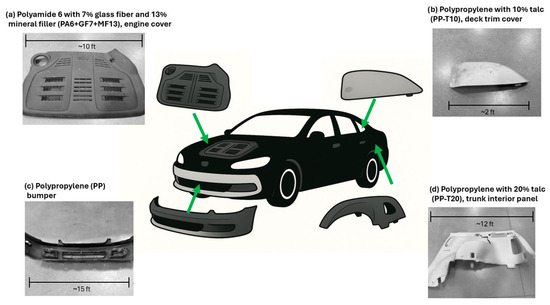
Moulded components such as bumpers, dashboards, trims, interior panels, and under-the-hood parts are often made from plastics like PP, ABS, PC, PA, and composite blends. These parts are ideal for circular economy practices because they can be:
Recycled multiple times
Manufactured using secondary materials
Reprocessed with minimal energy
Designed for easy end-of-life separation
3. Key Circular Strategies in Moulded Auto Component Manufacturing
a. Use of Recycled Polymers
Automotive OEMs increasingly incorporate post-industrial recycled (PIR) and post-consumer recycled (PCR) plastics. Examples include:
Recycled PP in bumpers and wheel arch liners
Recycled PET for interior trims
Recycled ABS in electronic housings and dashboards
Advances in compounding ensure recycled materials match virgin-grade properties.
b. Design for Disassembly (DfD)
Strategic design modifications enable:
Easy removal of components during vehicle dismantling
Separation of different polymers and metal inserts
Reduced contamination in recycling streams
Clip-fit joints, modular parts, and standardized fasteners support efficient end-of-life recovery.
c. Closed-Loop Material Systems
In a circular model, waste generated during injection moulding—sprues, runners, and rejected parts—is:
Ground, reprocessed, and reintegrated into new moulded products
Used directly within the same production line
Returned to material suppliers for remanufacturing
This reduces raw material costs and waste disposal requirements.
d. Lightweighting Through Material Optimization
Circularity also promotes lightweight design, which:
Reduces vehicle weight
Lowers fuel consumption
Enables reduced material usage per component
Advanced composites, foamed plastics, and optimized mould flow designs support lighter yet stronger parts.
e. Bio-based and Biodegradable Alternatives
Some OEMs experiment with bio-based polymers (PLA blends, bio-polyamides, natural fibre composites), which reduce reliance on fossil resources. These are particularly useful in non-structural interior components.
4. Benefits of Circular Economy for Automotive Manufacturers
Economic Benefits
Lower material costs through recycled inputs
Stable supply chains due to reduced dependency on virgin resins
New business opportunities in recycling and remanufacturing
Environmental Benefits
Reduced CO₂ emissions
Lower waste generation
Conservation of natural resources
Regulatory Compliance
Circular strategies help meet global policies such as:
End-of-Life Vehicles (ELV) Directive
Extended Producer Responsibility (EPR)
Corporate sustainability and ESG reporting requirements
5. Challenges in Implementing Circularity
Despite its advantages, manufacturers face certain challenges:
Maintaining consistent quality in recycled materials
Managing complex supply chains for recycled polymers
Designing compatible components for circular systems
Limited recycling infrastructure in emerging markets
However, technological advancements and growing regulatory pressure are accelerating the shift.
6. Future Outlook
Circular economy models will significantly shape the automotive sector’s future. Innovations likely to expand include:
Chemical recycling for high-grade plastic recovery
Digital product passports for tracking material origins
Smart moulds for material efficiency monitoring
High-performance composite recycling technologies
By integrating circular practices, moulded auto component manufacturers can achieve long-term sustainability, reduce operational costs, and stay competitive in an evolving industry.