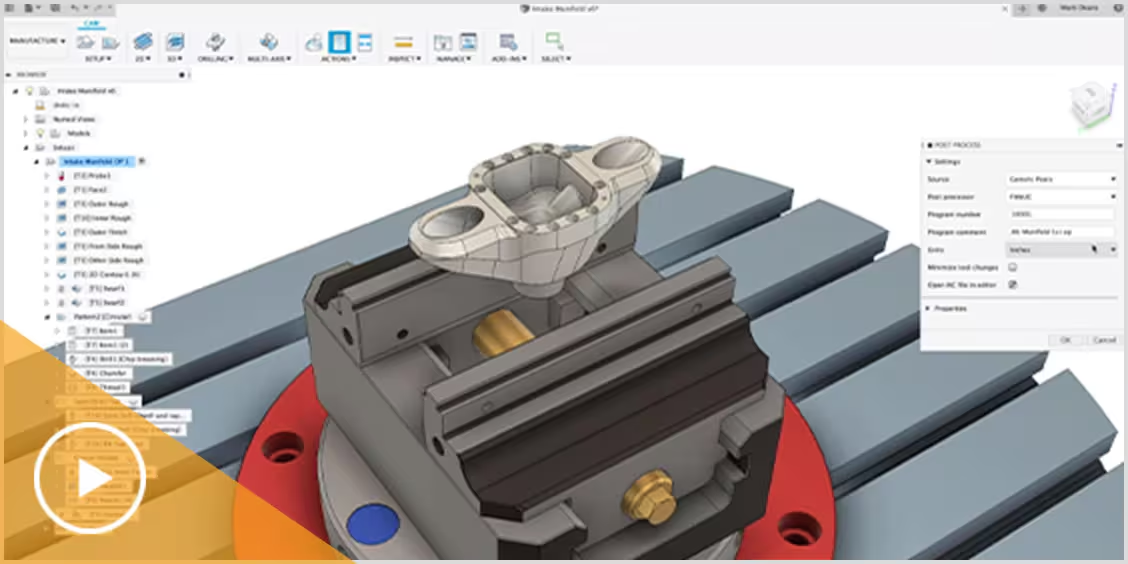
Die design is a crucial aspect of manufacturing processes such as metal stamping, plastic molding, and die casting. It involves creating tools (dies) that shape or cut materials into desired forms. The use of CAD (Computer-Aided Design) and CAM (Computer-Aided Manufacturing) software has revolutionized die design by increasing accuracy, efficiency, and flexibility in the design and manufacturing stages. Here’s an overview of commonly used CAD/CAM software in die design:
1. AutoCAD
Type: CAD
Developer: Autodesk
Use in Die Design:
AutoCAD is widely used for 2D and 3D modeling of die components. Designers use it to create detailed technical drawings of die layouts, including dimensions, tolerances, and assembly instructions.Strengths:
Precise 2D drafting
Good for simple die layouts
Widely supported file formats (e.g., DWG, DXF)
2. SolidWorks
Type: CAD
Developer: Dassault Systèmes
Use in Die Design:
SolidWorks is used for 3D parametric modeling, assembly design, and simulation. It is especially useful for designing complex die components, such as progressive dies, with motion simulation.Strengths:
User-friendly interface
Excellent part and assembly modeling
Integrated simulation and analysis tools
3. CATIA
Type: CAD/CAM
Developer: Dassault Systèmes
Use in Die Design:
CATIA is used in high-end die design applications, particularly in aerospace and automotive industries. It supports advanced surface modeling and can handle complex die shapes and assemblies.Strengths:
Powerful surfacing tools
Ideal for large, complex assemblies
Integration with product lifecycle management (PLM)
4. Siemens NX (formerly Unigraphics)
Type: CAD/CAM/CAE
Developer: Siemens
Use in Die Design:
NX is a comprehensive suite that supports the full die design process—from conceptual design to manufacturing. It offers specialized modules for stamping die design, mold design, and machining.Strengths:
Advanced automation tools (e.g., Die Wizard)
Integrated CAD/CAM environment
High-end simulation capabilities
5. Creo (formerly Pro/ENGINEER)
Type: CAD
Developer: PTC
Use in Die Design:
Creo is used for 3D modeling and simulation in die design, especially for plastic injection molds and sheet metal dies. It allows parametric design and offers mold design automation tools.Strengths:
Robust parametric modeling
Mold design automation
Integration with PTC Windchill for PLM
6. Mastercam
Type: CAM
Developer: CNC Software, LLC
Use in Die Design:
Mastercam is primarily a CAM tool used for programming CNC machines for die manufacturing. It imports CAD models and generates toolpaths for die machining.Strengths:
Industry-leading toolpath generation
Compatible with many CAD formats
Strong community and support
7. Delcam (now part of Autodesk – PowerShape, PowerMill)
Type: CAD/CAM
Developer: Autodesk
Use in Die Design:
PowerShape (CAD) and PowerMill (CAM) are used for complex mold and die design. They are particularly strong in working with complex surfaces and large data sets.Strengths:
Specialization in molds and dies
High-precision machining capabilities
Handles complex geometry efficiently
8. VISI
Type: CAD/CAM
Developer: Hexagon
Use in Die Design:
VISI is dedicated software for the toolmaking industry. It includes modules for 3D die design, strip layout, flow analysis, and electrode design for EDM.Strengths:
Industry-specific features
Strip layout and flow simulation
Integrated CAD/CAM environment
Benefits of Using CAD/CAM in Die Design
Increased Accuracy: Reduces human error and ensures precise tolerances.
Improved Efficiency: Speeds up the design-to-manufacturing cycle.
Simulation and Validation: Detects design flaws before physical prototyping.
Automation: Reuse of templates and standard components reduces design time.
Collaboration: Facilitates data sharing and concurrent engineering.
Conclusion
CAD/CAM software plays a pivotal role in modern die design, enhancing productivity, accuracy, and innovation. The choice of software depends on the complexity of the die, industry requirements, and integration with manufacturing processes. With continued advancements in CAD/CAM technology, the die design process is becoming more streamlined, automated, and intelligent.