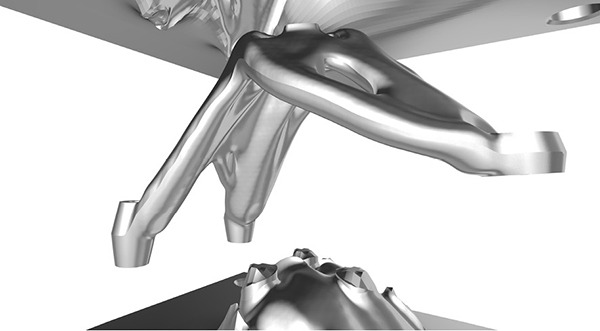
Die design plays a critical role in manufacturing processes such as metal forming, injection molding, and die casting. The quality, efficiency, and cost-effectiveness of the final product are heavily influenced by how well the die is designed. Traditionally, die design has relied on expert knowledge, trial-and-error methods, and computational simulations like Finite Element Analysis (FEA). However, with the advent of Artificial Intelligence (AI) and Machine Learning (ML), the die design process is undergoing a major transformation toward higher accuracy, reduced cycle times, and improved optimization.
1. Role of AI and ML in Die Design
AI and ML technologies are now being integrated into the die design workflow to automate and enhance decision-making, reduce design iterations, and predict performance outcomes. Their contributions can be seen in the following areas:
Design Automation: AI algorithms can automatically generate and evaluate die geometries based on input parameters like material properties, product geometry, and processing conditions.
Optimization: Machine learning models can optimize complex design parameters (e.g., cavity shape, cooling channel layout, gate location) for better material flow, reduced defects, and minimal material wastage.
Defect Prediction: ML algorithms can predict common die-related defects such as warping, cracking, or incomplete filling, based on past simulation or production data.
Material Behavior Modeling: AI can help in more accurately modeling how materials behave under pressure and temperature, aiding in better die life estimation.
2. Techniques Used
Several AI and ML techniques are employed for die design optimization, including:
Artificial Neural Networks (ANNs): Used for modeling nonlinear relationships between input and output parameters. For example, predicting product quality based on die geometry and process parameters.
Genetic Algorithms (GA) and Evolutionary Algorithms: Used for multi-objective optimization, such as minimizing die wear while maximizing production speed.
Support Vector Machines (SVM): Useful in classification problems, like identifying whether a design will pass or fail based on input features.
Reinforcement Learning (RL): Applied to sequential decision-making problems in adaptive die design systems.
Surrogate Modeling: Uses AI to build fast approximations of expensive simulations (e.g., FEA), enabling quicker design iterations.
3. Applications in Die Design Processes
AI and ML are transforming various stages of die design, such as:
Metal Forming: AI can optimize blank shape, die curvature, and process parameters to reduce springback and thinning in sheet metal operations.
Injection Molding: ML can optimize gate locations, cooling channel layouts, and cycle times to improve mold performance and product quality.
Die Casting: AI can help control solidification rates, predict porosity, and optimize die cooling to enhance casting quality and tool life.
4. Benefits of AI-Driven Die Design
Faster Design Cycles: Automated evaluation and optimization reduce the need for physical prototyping and iterative simulations.
Improved Product Quality: By predicting and preventing defects early, AI ensures higher-quality outputs.
Reduced Costs: Optimal die design reduces material usage, tooling costs, and energy consumption.
Knowledge Capture: AI systems can learn from past projects and retain expert knowledge, which is valuable for training new engineers.
Adaptive Design: Real-time data from production can feed into ML models to continuously update and improve die performance over time.
5. Challenges and Considerations
While the integration of AI and ML in die design offers numerous benefits, several challenges remain:
Data Requirements: High-quality, labeled data is essential for training accurate ML models, which may not always be available.
Interpretability: Complex AI models can act as “black boxes,” making it hard to understand why a certain decision or prediction was made.
Integration with Existing Tools: Aligning AI systems with traditional CAD, CAM, and CAE tools requires interoperability and standardization.
Domain Expertise: AI cannot fully replace human expertise; rather, it complements it. Engineers still need to validate and interpret AI-driven recommendations.
6. Future Trends
Hybrid Modeling: Combining physics-based simulations with AI models for more robust predictions.
Real-Time Monitoring & Feedback: Integrating sensor data from smart manufacturing systems into AI models for live optimization.
Cloud-Based AI Platforms: Leveraging cloud computing for scalable design simulations and AI model training.
Generative Design: AI algorithms that can autonomously generate multiple viable die designs based on constraints and objectives.
Conclusion
AI and Machine Learning are revolutionizing die design optimization by enabling faster, smarter, and more efficient workflows. While challenges like data availability and model interpretability remain, the benefits in terms of cost savings, quality improvements, and design innovation are significant. As AI tools continue to evolve and integrate with manufacturing systems, the future of die design lies in intelligent, data-driven, and adaptive solutions.