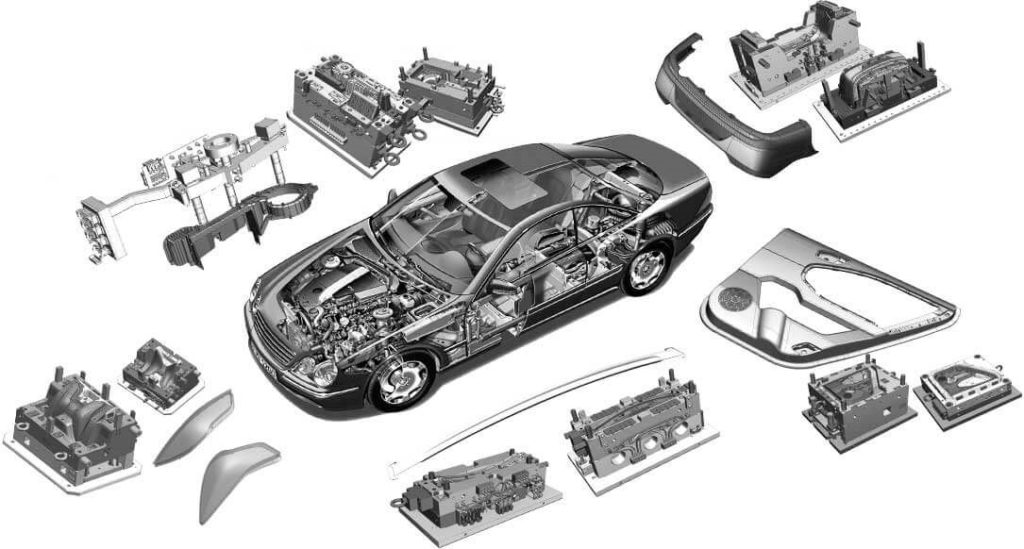
The automotive industry has seen a tremendous transformation over the last century, not just in design and performance, but also in the manufacturing technologies that make vehicles possible. Among these, moulding technology plays a critical role, enabling the production of precise, lightweight, and high-performance components. From early casting methods to today’s advanced injection moulding and 3D printing techniques, the evolution of moulding technology reflects the industry’s constant drive for efficiency, safety, and sustainability.
1. Early Days – Metal Casting and Handcrafting (1900s–1940s)
Sand casting and die casting were the primary moulding techniques used for producing engine blocks, transmission housings, and other metal components.
Vehicle bodies were largely hand-built from sheet metal, often over wooden frames.
Moulding was labor-intensive, slow, and lacked the precision modern cars require.
Materials: Predominantly steel and cast iron, with some early experimentation in aluminum.
2. Post-War Advancements and the Rise of Plastics (1950s–1970s)
The post-WWII industrial boom introduced mass production efficiencies.
Thermoplastics and thermosetting plastics began to replace metal in non-structural components like dashboards, knobs, and trim parts.
Compression moulding and blow moulding gained traction, especially for fuel tanks and interior parts.
Benefits included weight reduction, cost savings, and more design flexibility.
3. Injection Moulding Revolution (1980s–1990s)
Injection moulding became the dominant technique for manufacturing plastic components at scale.
Enabled high-volume, high-precision, and complex geometry production.
Common applications included:
Interior panels and consoles
Lighting housings
Bumpers and grilles
Introduction of composite materials (glass-filled plastics, carbon fiber-reinforced polymers) for improved strength-to-weight ratio.
CAD and CAM systems enhanced mould design accuracy and efficiency.
4. Lightweighting and Material Innovation (2000s–2010s)
Growing pressure for fuel efficiency and lower emissions drove the use of lighter materials.
Advanced composites, multi-material moulding, and co-injection moulding became common.
Examples:
Plastic-metal hybrid parts for crash structures
Lightweight dashboards with integrated electronics
Use of engineered polymers that withstand high temperatures and mechanical stress in engine compartments and under-the-hood applications.
5. Digital Manufacturing and 3D Printing (2010s–Present)
Additive manufacturing (3D printing) is now used for prototyping and low-volume parts.
Digital mould design using simulation tools (CAE, FEA) accelerates development and reduces trial-and-error.
Rapid prototyping reduces time-to-market for new models.
Tooling for moulds is increasingly made with automated CNC machines and hybrid manufacturing methods.
Rise of smart moulding with sensors embedded in moulds to monitor pressure, temperature, and quality in real time.
6. Towards Sustainability and Electric Vehicles (2020s–Future)
The shift to electric vehicles (EVs) brings new requirements:
More cooling systems
Battery casings and insulation materials
Lightweight and flame-retardant components
Sustainable materials such as bio-based plastics, recycled polymers, and natural fiber composites are gaining importance.
Focus on closed-loop manufacturing and recyclability of moulded parts.
AI and machine learning are beginning to influence mould design, defect prediction, and process optimization.
Conclusion
The evolution of moulding technology in the auto industry reflects broader trends in manufacturing innovation, material science, and sustainability. From early casting to AI-powered smart moulding systems, each stage has enabled better performance, reduced costs, and greater design freedom. As the industry moves further into the electric and autonomous era, moulding technologies will continue to adapt, offering greener, smarter, and more efficient solutions.