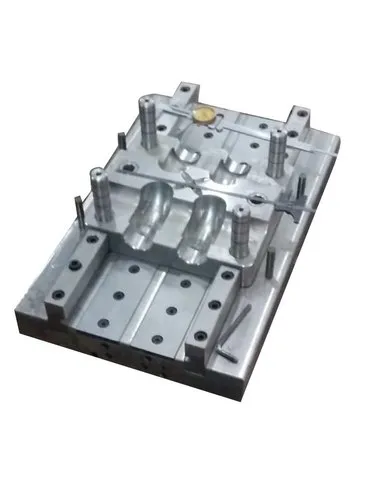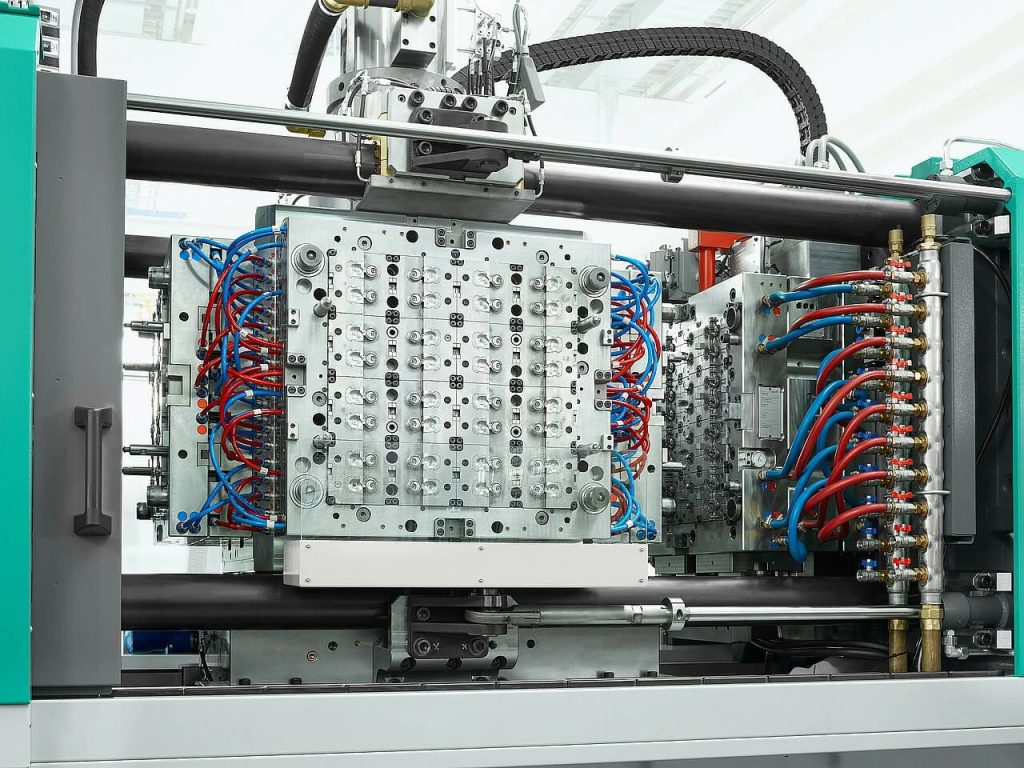
Stack moulds are advanced injection moulding systems designed to increase production capacity by incorporating two or more parting lines and sets of mould cavities within a single mould assembly. This configuration allows multiple layers of components to be produced during a single injection cycle, significantly increasing output without requiring a larger injection moulding machine.
In a stack mould, the mould cavities are arranged in multiple levels, typically using a central moving platen or an opening mechanism to separate the mould sections. Molten plastic is injected into the cavities through a balanced runner system, ensuring uniform material distribution across all levels. The mould then cools, opens, and ejects the finished components through a synchronized mechanism.
Stack moulds are widely used in the production of packaging components, bottle caps, closures, containers, thin-walled products, and other high-volume plastic components.
Key advantages include:
- Increased production output per injection cycle
- Improved machine utilization and manufacturing efficiency
- Higher production capacity without significantly increasing machine size
- Reduced production cost per component
- Efficient use of factory floor space
- Suitable for high-volume and automated manufacturing
- Consistent component quality across multiple mould levels
- Potential reduction in the number of machines required for large production volumes
Key Design Considerations
- Balanced Runner System: Ensure uniform distribution of molten plastic to all cavities and mould levels.
- Mould Opening Mechanism: Design a reliable opening sequence to ensure proper separation of the multiple parting lines.
- Clamping Force: Calculate the required clamping force based on the total projected area of all cavities.
- Cooling System: Provide efficient and balanced cooling across all mould levels to maintain consistent cycle times.
- Ejection System: Synchronize component ejection to ensure smooth and reliable part removal.
- Mould Alignment: Maintain accurate alignment and rigidity of the mould sections to prevent flash and dimensional inconsistencies.
- Machine Compatibility: Ensure that the injection moulding machine has sufficient platen space, opening stroke, clamping force, and injection capacity.
Stack moulds require precise engineering, careful balancing, and accurate synchronization of mould movements to achieve reliable performance. Although the initial mould design and manufacturing costs can be higher than those of conventional moulds, stack moulds can provide substantial productivity benefits in applications involving large production volumes.
A properly designed stack mould delivers higher output per cycle, optimized machine utilization, reduced production costs, and consistent product quality, making it an effective solution for high-volume injection moulding applications.