1. Introduction
Steel thermoforming moulds are moulds manufactured from steel and used to shape heated thermoplastic sheets into specific products. In the thermoforming process, a plastic sheet is heated until it becomes soft and flexible, placed over or into a mould, and formed into the required shape using vacuum, air pressure, mechanical force, or a combination of these methods.
Steel moulds are selected when high strength, durability, dimensional accuracy, wear resistance, and long production life are required.
They are commonly used in packaging, automotive components, medical product packaging, consumer goods, industrial trays, and other plastic products manufactured through thermoforming.
2. Definition of Steel Thermoforming Moulds
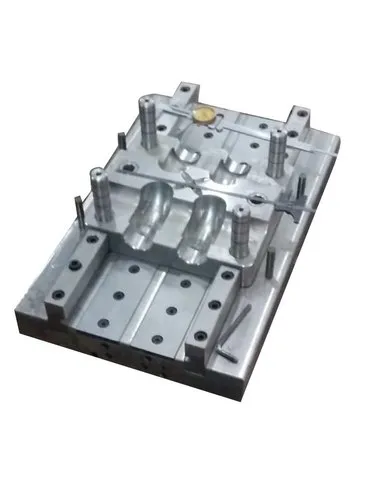
A steel thermoforming mould is a specially designed tool made from a suitable grade of steel that provides the required geometry for forming a heated plastic sheet.
The mould contains the shape and surface details that are transferred to the softened plastic during forming. Depending on the application, it may be designed as a male mould, female mould, or a matched set of mould halves.
The mould must withstand repeated heating and cooling cycles, forming forces, vacuum or pressure loads, and mechanical handling without excessive deformation or wear.
3. Materials Used for Steel Thermoforming Moulds
Different grades of steel are selected according to the required strength, surface finish, operating temperature, corrosion resistance, and production volume.
3.1 Mild Steel
Mild steel is a relatively economical material used for moulds in applications with moderate demands.
Characteristics:
- Relatively low material and machining costs.
- Good machinability and weldability.
- Suitable for simple mould geometries.
- May require protective coatings to prevent corrosion.
Applications: Prototype moulds, development tools, and certain low- to medium-volume production applications.
3.2 Carbon Steel
Carbon steel provides a range of strength, hardness, and wear characteristics depending on its composition and heat treatment.
Characteristics:
- Good structural strength.
- Available in different hardness conditions.
- Suitable for machining into detailed mould shapes.
- Corrosion resistance is generally limited without suitable protection.
Applications: General-purpose thermoforming tools and mould bases.
3.3 Alloy Steel
Alloy steels contain additional elements that can improve hardenability, toughness, strength, and wear resistance.
Characteristics:
- Good mechanical strength.
- Potential for improved wear resistance after suitable heat treatment.
- Suitable for demanding moulding conditions.
- Requires appropriate material selection and heat-treatment control.
Applications: Durable production moulds and mould components exposed to repeated mechanical loads.
3.4 Stainless Steel
Stainless steel is selected when corrosion resistance, cleanliness, or exposure to moisture and certain chemicals is important.
Characteristics:
- Improved corrosion resistance compared with ordinary carbon steel.
- Available in different grades with varying strength and machinability.
- Can provide a good surface finish.
- Often has a higher material and machining cost.
Applications: Specialized packaging tools, hygienic manufacturing environments, and applications requiring corrosion resistance.
3.5 Pre-Hardened and Tool Steel
Pre-hardened steels and suitable tool steels may be used where dimensional stability, wear resistance, and durability are important.
The appropriate grade depends on the forming temperature, loading, machining requirements, and expected production life. Steel selection should be based on the actual service conditions rather than hardness alone.
4. Main Components of a Steel Thermoforming Mould
4.1 Mould Cavity
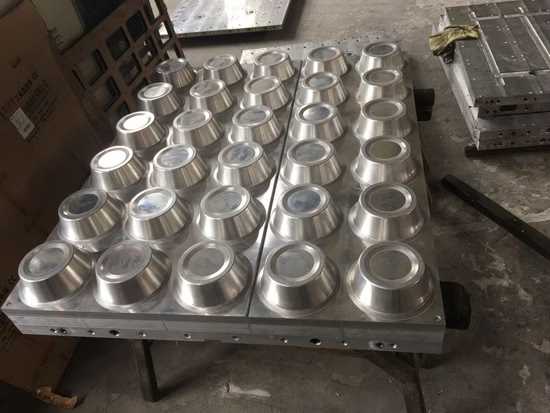
The cavity is the shaped region that determines the external geometry of the formed plastic product in a female mould.
It may contain recesses, contours, ribs, and other features corresponding to the product design.
4.2 Mould Core
A core is the projecting or male portion used to form the corresponding internal geometry of the plastic product.
Depending on the process and product design, thermoforming may use a male tool, a female tool, or matched mould halves.
4.3 Vacuum Holes and Channels
Vacuum holes allow air between the plastic sheet and the mould surface to escape during vacuum forming.
Their positions and sizes must be carefully designed to reproduce product details while minimizing visible marks on the finished part.
4.4 Cooling Channels
Cooling channels carry a cooling medium, usually water, through or around the mould.
They help control the mould temperature and remove heat from the formed plastic, allowing it to retain its shape during demoulding.
The cooling arrangement must provide suitable temperature distribution without creating unwanted thermal gradients.
4.5 Venting System
The venting system allows trapped air to escape from areas where the heated sheet contacts the mould.
Proper venting improves detail reproduction and reduces defects such as incomplete forming and trapped-air pockets.
4.6 Clamping and Mounting Plate
The mounting plate secures the mould to the thermoforming machine.
It provides structural support and helps maintain the correct alignment between the mould and the machine’s forming equipment.
4.7 Trimming and Registration Features
Some moulding systems incorporate registration features or work with separate trimming tools to ensure accurate positioning and consistent product dimensions.
Trimming may take place in the same station or in a separate operation, depending on the production system.
5. Types of Steel Thermoforming Moulds
5.1 Male Mould
A male mould has a projecting form over which the heated plastic sheet is drawn.
Advantages:
- Relatively straightforward construction.
- Useful for certain deep-drawn shapes.
- Can be suitable for specific internal surface requirements.
Limitations:
- Wall thickness may become uneven as the sheet stretches.
- Deep features may require additional forming assistance.
Applications: Covers, housings, trays, and shaped plastic components.
5.2 Female Mould
A female mould contains a cavity into which the heated plastic sheet is drawn.
Advantages:
- Can provide good control over external product details.
- Suitable for reproducing cavity geometry.
- Can provide good dimensional consistency with appropriate process control.
Limitations:
- Deep cavities may create material distribution challenges.
- Vacuum-hole placement and venting require careful design.
Applications: Packaging trays, containers, product housings, and formed panels.
5.3 Matched-Mould System
A matched-mould system uses corresponding male and female mould halves that close around the heated plastic sheet.
Depending on the process, mechanical force or pressure assists the sheet in conforming to the mould geometry.
Advantages:
- Can improve control over both sides of the component.
- Suitable for products requiring greater dimensional control.
- Can support more detailed or complex geometries.
Limitations:
- Higher tooling cost.
- Requires precise alignment and clearance control.
- More complex tooling and operating arrangements.
6. Manufacturing Process of Steel Thermoforming Moulds
The production of a steel thermoforming mould involves several engineering stages.
Step 1: Product design and analysis
The required product geometry, dimensions, draft angles, surface finish, and production volume are established.
Step 2: Material selection
A suitable steel grade is selected according to the expected operating conditions, required durability, corrosion resistance, and manufacturing budget.
Step 3: Mould design
The mould cavity or core is designed using CAD software. Vacuum holes, cooling passages, venting, mounting features, and other necessary details are incorporated.
Step 4: Steel preparation
The steel block or plate is cut to the required dimensions and prepared for machining.
Step 5: CNC machining
Computer numerical control (CNC) milling, drilling, turning, or other machining operations produce the required geometry.
Step 6: Heat treatment
Where required, the steel undergoes hardening, tempering, stress relief, or another suitable heat-treatment process. The timing depends on the selected grade and manufacturing route.
Step 7: Surface finishing
The mould surface is machined, polished, textured, or otherwise finished according to the requirements of the formed product.
Step 8: Installation of channels and accessories
Vacuum connections, cooling fittings, mounting elements, and other components are installed.
Step 9: Inspection and testing
The mould is inspected for dimensional accuracy, surface quality, channel integrity, and correct mounting.
Step 10: Trial forming
A trial production run is conducted to verify forming quality, material distribution, cooling performance, and demoulding behavior.
7. Working Principle of Steel Thermoforming Moulds
The thermoforming process generally follows these stages:
- Plastic sheet loading: A thermoplastic sheet is positioned in the thermoforming machine.
- Heating: The sheet is heated until it reaches a suitable forming temperature.
- Positioning: The softened sheet is brought into position over or around the steel mould.
- Forming: Vacuum, air pressure, mechanical assistance, or a combination of these methods forces the sheet to conform to the mould surface.
- Cooling: The formed plastic is cooled until it becomes sufficiently rigid.
- Demoulding: The finished component is removed from the mould.
- Trimming: Excess material is cut away when necessary.
- Inspection: The product is checked for dimensional accuracy, surface quality, and forming defects.
The exact sequence varies with the thermoforming machine, plastic material, mould design, and forming method.
8. Advantages of Steel Thermoforming Moulds
High Strength
Steel provides high structural strength and can withstand substantial mechanical loads when appropriately designed.
Long Service Life
Suitable steel grades can provide good wear resistance and durability over repeated production cycles.
Dimensional Stability
A properly designed and manufactured steel mould can maintain its geometry during repeated operation.
Good Surface Finish
Steel moulds can be polished or textured to produce the required finish on the plastic component.
Repairability
Certain steel moulds can be repaired, re-machined, or modified when product requirements change, subject to the material condition and mould design.
Suitability for Production
Steel tools can be suitable for medium- and high-volume production where the initial tooling investment is justified by durability and repeatability.
Temperature Resistance
Steel retains useful mechanical properties at typical thermoforming operating conditions, although the actual temperature capability depends on the grade and design.
9. Disadvantages of Steel Thermoforming Moulds
- High initial cost: Steel stock, machining, finishing, and inspection can make the mould expensive.
- Longer manufacturing time: Complex steel tooling may require extensive machining and finishing.
- High weight: Steel moulds are generally heavier than aluminium alternatives.
- Machining difficulty: Certain hardened or alloy steels require specialized machining methods.
- Corrosion risk: Carbon and some alloy steels need appropriate protection and maintenance.
- Thermal management: Steel generally conducts heat less effectively than aluminium, which can affect cooling time and temperature uniformity.
The practical importance of these disadvantages depends on mould geometry, production requirements, and the selected steel grade.
10. Applications of Steel Thermoforming Moulds
Steel thermoforming moulds are used in a range of industries.
| Industry | Typical applications |
|---|---|
| Packaging | Trays, containers, lids, and protective packaging |
| Automotive | Interior panels, covers, and selected trim components |
| Medical packaging | Trays and packaging components, subject to appropriate material and process controls |
| Consumer goods | Product housings, organizers, and covers |
| Industrial manufacturing | Protective covers, equipment panels, and formed components |
| Electronics | Protective packaging and selected equipment enclosures |
| Appliances | Internal liners, covers, and decorative panels |
Steel moulds are particularly relevant when the required tooling durability, geometry, or service conditions justify their cost.
11. Factors Affecting Steel Mould Performance
Steel Grade
The material must have suitable strength, machinability, wear resistance, and corrosion resistance for the intended application.
Mould Design
Poorly designed cavities, inadequate venting, or unsuitable draft angles can cause incomplete forming, difficult demoulding, and inconsistent product quality.
Surface Finish
The mould surface affects the appearance and release behavior of the formed plastic. The correct finish depends on the product’s visual and functional requirements.
Cooling Efficiency
Uneven cooling can cause warpage, dimensional variation, and longer production cycles. Cooling channels should be designed to provide suitable temperature uniformity.
Forming Temperature
The plastic sheet must reach an appropriate forming temperature. Incorrect heating can cause thinning, sagging, incomplete forming, or degradation.
Vacuum and Pressure Control
Vacuum or pressure must be sufficient to form the plastic against the mould. Poor control can result in incomplete details and uneven material distribution.
Maintenance
Regular inspection, cleaning, corrosion protection, and checks of the vacuum and cooling systems help maintain mould performance.
12. Common Defects and Troubleshooting
| Defect | Possible cause | Corrective action |
|---|---|---|
| Incomplete forming | Insufficient vacuum or unsuitable sheet temperature | Check vacuum performance and heating conditions |
| Uneven wall thickness | Excessive stretching or unsuitable mould geometry | Review material distribution and forming method |
| Warpage | Uneven cooling or premature demoulding | Improve cooling uniformity and release timing |
| Surface marks | Mould damage, contamination, or unsuitable finishing | Clean and inspect the mould surface |
| Difficulty in demoulding | Insufficient draft or excessive friction | Review draft angles and release conditions |
| Bubbles or blisters | Moisture, overheating, or trapped gases | Check material condition and heating parameters |
| Poor detail reproduction | Inadequate vacuum, blocked vents, or unsuitable temperature | Inspect venting and vacuum channels |
13. Maintenance of Steel Thermoforming Moulds
Proper maintenance is essential for consistent production and longer mould life.
- Clean the mould surface regularly to remove plastic residues and contamination.
- Inspect vacuum holes and channels for blockages.
- Check cooling channels and fittings for leakage or restricted flow.
- Inspect the mould surface for scratches, corrosion, and wear.
- Apply suitable corrosion protection during storage.
- Check mounting points and alignment before production.
- Verify the mould dimensions periodically, especially for critical features.
- Repair damaged surfaces using an appropriate method for the steel grade and mould design.
- Record maintenance activities and monitor recurring production defects.
Maintenance procedures should follow the tooling manufacturer’s recommendations.
14. Steel Thermoforming Moulds Compared with Aluminium Moulds
| Feature | Steel moulds | Aluminium moulds |
|---|---|---|
| Strength and stiffness | Generally high | Depends on alloy and design |
| Weight | Generally heavier | Generally lighter |
| Thermal conductivity | Generally lower | Generally higher |
| Machining | Can be more time-consuming | Often easier and faster |
| Initial tooling cost | Can be relatively high | Often lower for comparable simple tooling |
| Wear resistance | Can be high with suitable grade and treatment | Depends on alloy and surface treatment |
| Corrosion resistance | Depends on steel grade and protection | Depends on alloy and surface treatment |
| Typical suitability | Durable or demanding tooling applications | Rapid heating and cooling, prototypes, and many production applications |
Neither material is universally superior. Aluminium is often attractive where rapid heat transfer and reduced weight are priorities, while steel may be preferred where particular strength, wear, or durability requirements justify its additional cost.
15. Conclusion
Steel thermoforming moulds are durable tooling solutions used to shape heated thermoplastic sheets into components with defined geometries, surface finishes, and dimensions.
Their performance depends on the steel grade, mould design, machining accuracy, surface finish, cooling arrangement, vacuum or pressure control, and maintenance practices.
Although steel moulds can involve higher initial costs and longer manufacturing times than some alternatives, they offer useful advantages in strength, durability, and dimensional stability.
The main objective of steel thermoforming mould design is to produce accurate, repeatable plastic components while maintaining efficient forming, cooling, demoulding, and long-term tooling performance.