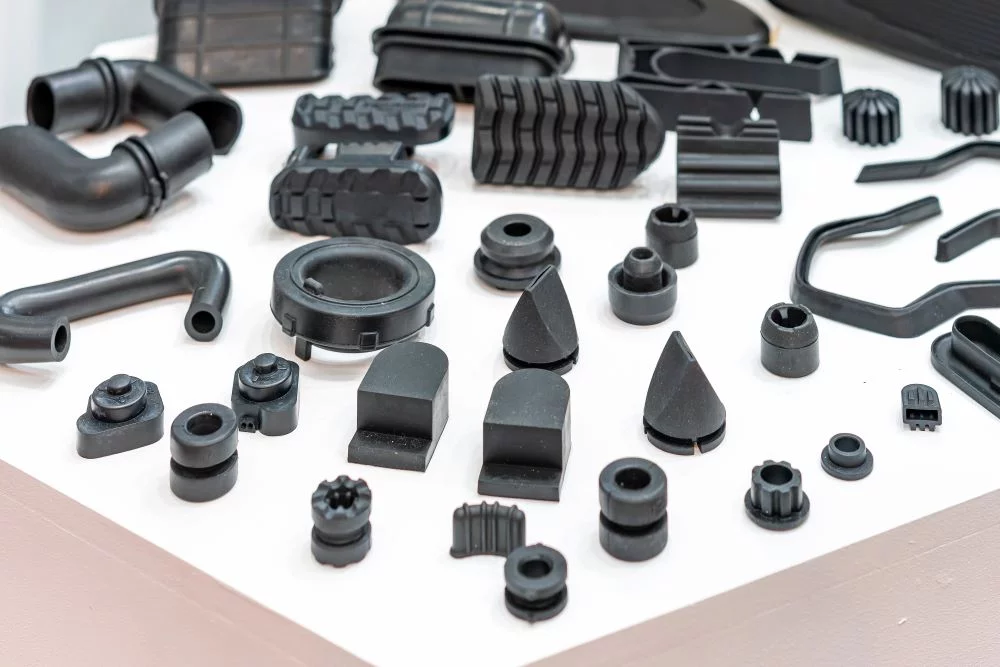
Manufacturing automotive components involves choosing the right moulding process to meet requirements such as strength, weight, cost, and complexity. Injection moulding and compression moulding are two commonly used techniques, each with distinct advantages and limitations.
1. Overview of Processes
| Feature | Injection Moulding | Compression Moulding |
|---|---|---|
| Process | Molten thermoplastic or thermoset resin is injected into a closed mould under high pressure. | Preheated polymer (usually thermoset) is placed into a heated open mould, then compressed to fill the cavity. |
| Material Flow | High-pressure injection fills the mould rapidly. | Material flows under pressure from a fixed charge. |
| Cycle Time | Shorter (seconds to a few minutes). | Longer (typically several minutes). |
2. Materials Used
Injection Moulding: Primarily thermoplastics (e.g., PP, ABS, Nylon), but also some thermosets.
Compression Moulding: Mostly thermosetting plastics (e.g., phenolic, epoxy), fiber-reinforced polymers (FRPs), and composites.
3. Automotive Applications
| Injection Moulding | Compression Moulding |
|---|---|
| Dashboards, door panels, instrument clusters | Hoods, fenders, structural panels |
| Clips, fasteners, air vents | Bumpers, battery covers, underbody shields |
| Light housings, connectors | Carbon fiber reinforced components |
4. Advantages
Injection Moulding
High precision and repeatability
Suitable for complex and detailed parts
Fast production cycles
Automation-friendly
Ideal for high-volume production
Compression Moulding
Better for large, strong, structural parts
Handles high fiber content for reinforced composites
Lower tooling cost for small runs
Less material waste in some cases
5. Limitations
Injection Moulding
High initial tooling cost
Not ideal for very large or thick parts
Material shrinkage can cause dimensional issues
Compression Moulding
Lower dimensional precision
Limited to simpler geometries
Slower cycle times
Less automation potential
6. Cost Comparison
Tooling Cost: Injection moulding has higher upfront tooling costs but becomes economical at high volumes.
Per-Part Cost: Lower in injection moulding for large-scale production; compression moulding may be cost-effective for lower volumes or large parts.
7. Mechanical Properties
Compression moulded parts often have better mechanical strength, especially with continuous or chopped fiber reinforcement.
Injection moulded parts offer good strength-to-weight ratios but are generally weaker for structural loads unless reinforced.
8. Sustainability and Waste
Injection Moulding: Generates more sprue and runner waste, but recyclable thermoplastics are common.
Compression Moulding: Less waste in some cases, but materials (especially thermosets) are often not recyclable.