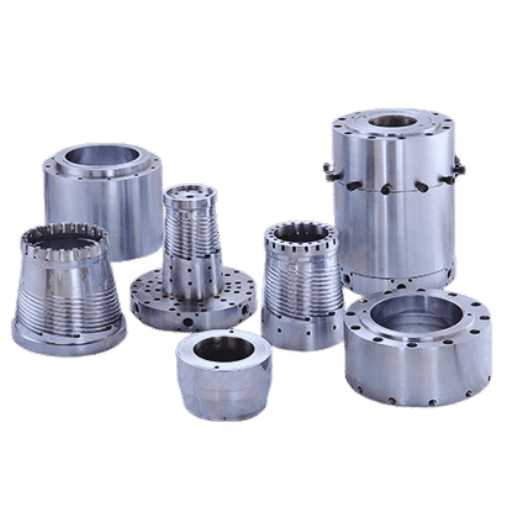
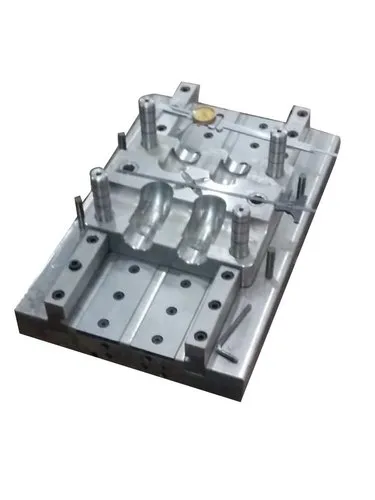
Extrusion Blow Moulding (EBM) is a manufacturing process used to produce hollow plastic parts, such as bottles, containers, and tanks. A critical component in this process is the die head, which plays a fundamental role in shaping the molten plastic (parison) before it is inflated inside a mould. The design of the die head directly influences product quality, material efficiency, and production consistency.
1. Overview of the Die Head in EBM
The die head is the part of the extrusion blow moulding machine where molten plastic from the extruder is gathered and formed into a tubular parison. It determines the wall thickness distribution and flow characteristics of the plastic, making it one of the most crucial parts of the EBM process.
2. Functions of Die Head Design
a. Control of Wall Thickness
The die head determines the initial wall thickness of the parison.
Modern die heads may include programmed parison control that adjusts die gap dynamically to control wall thickness along the length of the parison.
Proper thickness control ensures even material distribution, minimizing weak spots and reducing material usage.
b. Flow Distribution
Ensures uniform flow of molten plastic around the circumference of the die.
Helps in achieving symmetrical parisons, which is essential for uniform inflation and consistent wall thickness in the final product.
Poor flow design can cause parison sagging or uneven stretching, leading to defects.
c. Support for Multi-Layer Structures
Advanced die heads can handle co-extrusion, allowing multiple polymer layers to be extruded simultaneously.
This is essential for products that require barrier properties, recycled core layers, or aesthetic outer layers.
3. Types of Die Heads in EBM
a. Center Feed Die Head
Material enters the die head centrally and flows outward.
Provides uniform parison formation and is commonly used for symmetrical parts.
b. Side Feed Die Head
Material enters from the side and is distributed around the mandrel.
More compact but can cause uneven distribution if not designed properly.
c. Accumulator Die Head
Stores molten material in a chamber before pushing it out in a single shot.
Suitable for large parts like tanks or automotive components.
4. Die Gap and Mandrel Design
Die gap refers to the opening between the mandrel and die ring, through which molten plastic flows.
The shape and size of the mandrel influence flow rate and parison shape.
Variable die gap designs allow for parison programming, where thickness is adjusted during extrusion to suit product geometry.
5. Material Compatibility and Heating
Die heads must be designed to handle different materials (e.g., HDPE, PP, PETG) with varying melt viscosities.
Efficient heating systems within the die head ensure consistent temperature and prevent thermal degradation.
6. Influence on Product Quality
A well-designed die head contributes to:
Uniform wall thickness, reducing material waste and improving strength.
Better surface finish and dimensional accuracy.
Reduced cycle time and energy consumption due to improved flow dynamics.
Conclusion
In extrusion blow moulding, die head design is pivotal to the efficiency and effectiveness of the process. From controlling wall thickness and flow distribution to enabling multi-layer co-extrusion, the die head shapes not only the parison but also the final quality of the moulded product. Continuous innovation in die head technology is enabling manufacturers to produce lighter, stronger, and more sustainable plastic components across various industries.