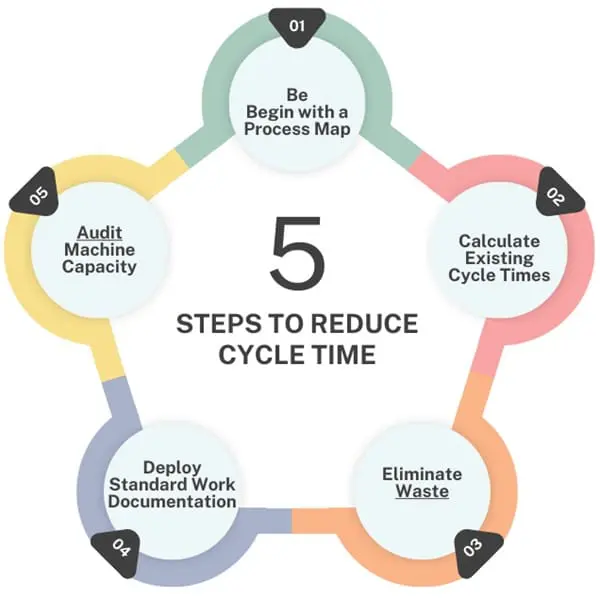
Cycle Time refers to the total time taken from the beginning to the end of a process, including processing time, waiting time, and any delays. Reducing cycle time is crucial for improving efficiency, lowering costs, and increasing customer satisfaction.
Why Reduce Cycle Time?
Faster delivery to customers
Reduced operational costs
Improved productivity and throughput
Enhanced process efficiency
Competitive advantage
Key Techniques for Cycle Time Reduction
1. Value Stream Mapping (VSM)
A lean tool used to visualize all steps in a process.
Helps identify and eliminate non-value-added activities.
Enables targeted improvements for time reduction.
2. Eliminate Non-Value-Added Activities (NVA)
Analyze each process step to determine if it adds value.
Remove or streamline activities like excessive approvals, manual data entry, and unnecessary transportation.
3. Standardization of Work
Establish clear and consistent methods for performing tasks.
Reduces variability and rework.
Ensures consistent cycle times across operators.
4. Process Automation
Use technology to automate repetitive or time-consuming tasks (e.g., data entry, reporting, quality checks).
Reduces manual errors and accelerates processes.
5. Parallel Processing
Perform tasks concurrently instead of sequentially.
Useful in administrative processes, software development, and manufacturing.
6. Bottleneck Identification and Management
Locate the step in the process that limits overall throughput.
Apply resources or redesign that step to increase flow rate.
7. Continuous Flow and Just-in-Time (JIT) Production
Keep materials and tasks moving without interruption or queues.
Reduce wait times and inventory buildup.
8. Cross-Training Employees
Train employees on multiple tasks.
Enhances flexibility, reduces delays due to unavailability, and improves resource utilization.
9. Set-Up Time Reduction (SMED – Single-Minute Exchange of Die)
Reduce the time required to switch from one task or product to another.
Especially valuable in manufacturing environments.
10. Root Cause Analysis for Delays
Use tools like the 5 Whys or Fishbone Diagram to find root causes of delays.
Implement corrective actions to prevent recurrence.
11. Use of Lean Six Sigma Tools
DMAIC (Define, Measure, Analyze, Improve, Control) methodology helps structure improvements.
Statistical tools help validate changes and measure results.
Measuring Cycle Time Reduction
To ensure effectiveness:
Establish Baselines: Measure current cycle times.
Set Targets: Define realistic, data-driven goals.
Monitor Progress: Use dashboards, KPIs, and metrics.
Review and Improve Continuously.
Conclusion
Cycle time reduction is a powerful strategy for enhancing operational efficiency and responsiveness. By applying structured techniques and embracing a culture of continuous improvement, organizations can achieve faster turnaround, higher customer satisfaction, and significant cost savings.