1. Introduction
In die and mould design, tolerances and fits are crucial concepts that directly influence the accuracy, functionality, interchangeability, and cost of manufactured components. They determine how precisely parts are manufactured and how they will fit together during assembly.
2. What is Tolerance?
Tolerance is the permissible limit or limits of variation in a physical dimension or measured value. It specifies the range within which a dimension can vary without affecting the performance or assembly of a component.
Types of Tolerances:
Unilateral Tolerance: Variation allowed in only one direction (either positive or negative).
Bilateral Tolerance: Variation allowed in both directions from the nominal dimension.
Limit Dimensions: The maximum and minimum size that a part can have.
Example:
If a pin is to be manufactured as Ø10 mm ± 0.02 mm, the diameter can range from 9.98 mm to 10.02 mm.
3. What is Fit?
Fit is the relationship between two mating parts – typically a hole and a shaft – in terms of the tightness or looseness of the joint they form.
Types of Fit:
Clearance Fit: Always provides clearance between mating parts.
Interference Fit: Always provides an overlap; parts must be pressed together.
Transition Fit: May result in either a small clearance or a slight interference.
4. Importance in Die and Mould Design
In die and mould making, tolerances and fits are used for:
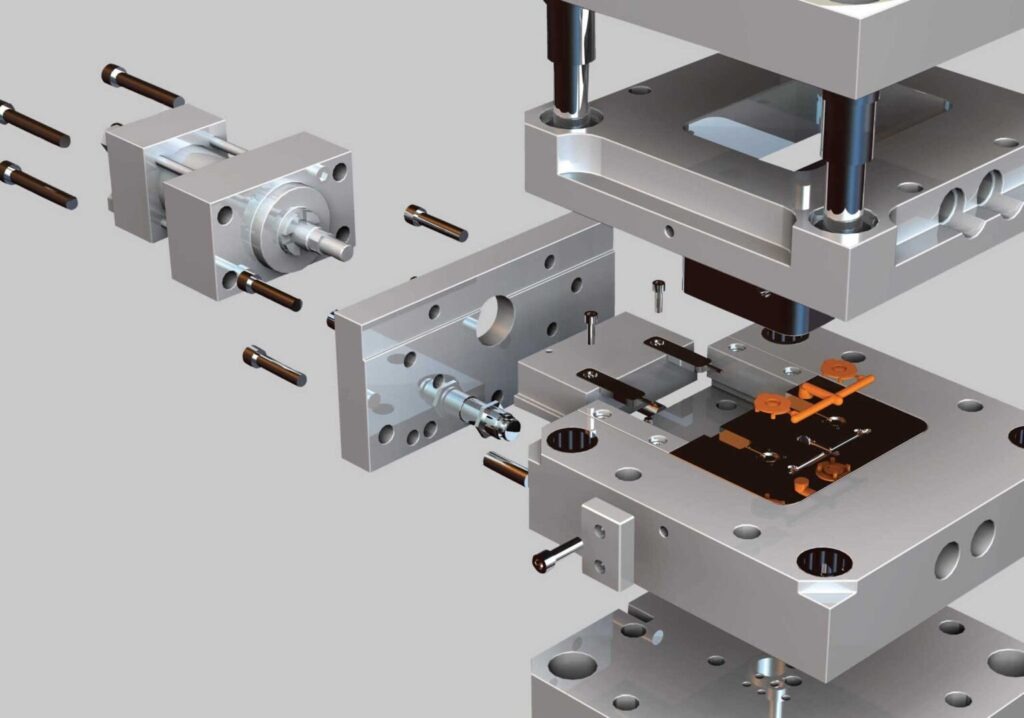
Ensuring precision in core and cavity alignment.
Facilitating proper assembly of die/mould components.
Avoiding excessive wear and extending tool life.
Maintaining dimensional accuracy of the final molded or formed parts.
Allowing for thermal expansion and shrinkage compensation in materials.
Reducing rework and assembly issues.
5. Common Applications in Die & Mould Design
| Component | Typical Tolerance/Fit | Purpose |
|---|---|---|
| Guide pins and bushings | Interference fit or close transition | Ensures precise alignment |
| Cavity inserts | Close sliding or light interference | Easy replacement, precise location |
| Ejector pins | Clearance fit | Free movement during part ejection |
| Core and cavity | Tight tolerance | Dimensional accuracy of molded parts |
| Die shoes and plates | Clearance fit | Easy assembly and disassembly |