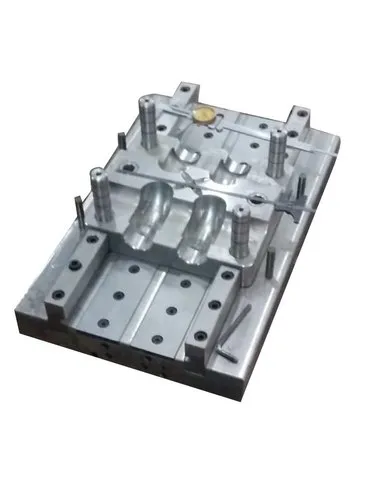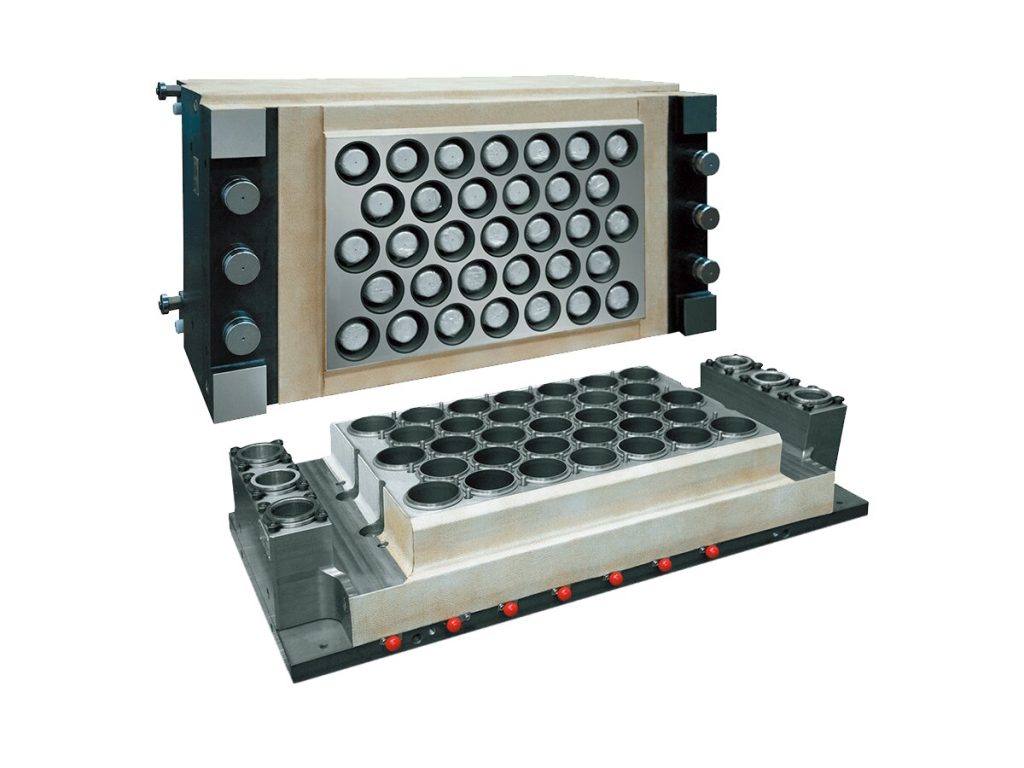
Twin-sheet thermoforming moulds are moulding tools used in a thermoforming process where two separate thermoplastic sheets are heated and formed simultaneously. The two formed sheets are then joined together around their edges to create a hollow, lightweight, and rigid component.
This process is particularly useful for manufacturing products that need an enclosed or hollow structure, such as tanks, containers, pallets, automotive components, ducts, and large industrial housings.
How Twin-Sheet Thermoforming Works
The basic process involves the following steps:
- Two plastic sheets are loaded into the thermoforming machine.
- Both sheets are heated to their forming temperature.
- Each heated sheet is positioned over its respective mould.
- Vacuum and/or air pressure is applied to form the sheets against the mould surfaces.
- The two moulds move together while the sheets are still hot.
- The edges of the two formed sheets are pressed and fused together.
- The component is cooled and removed from the mould.
- Excess material is trimmed to obtain the final shape.
Main Components of a Twin-Sheet Thermoforming Mould
| Component | Function |
|---|---|
| Upper Mould | Forms one side of the product |
| Lower Mould | Forms the opposite side |
| Vacuum Channels | Remove air between sheet and mould |
| Air/Pressure System | Helps form the heated sheets |
| Clamping System | Holds sheets securely |
| Sealing Area | Helps join the two sheets |
| Cooling System | Controls mould temperature |
| Venting System | Allows trapped air to escape |
| Trimming Area | Helps remove excess plastic |
Types of Twin-Sheet Moulds
1. Male–Male Moulds
Both sheets are formed over male mould surfaces. They are useful when specific external shapes are required.
2. Female–Female Moulds
Both sheets are formed inside female cavities, providing detailed external surfaces.
3. Male–Female Moulds
One sheet is formed over a male mould while the other is formed inside a female mould. This arrangement can provide different surface characteristics on each side.
Materials Used for Moulds
Twin-sheet thermoforming moulds can be manufactured from:
- Aluminum
- Epoxy tooling materials
- Polyurethane tooling boards
- Composite materials
- CNC-machined tooling materials
Aluminum moulds are commonly preferred for production applications because they provide good durability and heat transfer.
Advantages of Twin-Sheet Thermoforming
- Produces hollow and lightweight components
- Can create complex three-dimensional shapes
- Allows two sheets to be joined during forming
- Can provide good structural rigidity
- Suitable for large components
- Can incorporate internal spaces and cavities
- Reduces the need for separate assembly of two formed halves
- Suitable for many thermoplastic materials
Limitations
- Tooling can be more complicated than conventional thermoforming.
- Precise alignment of the two moulds is important.
- Sheet temperature must be carefully controlled.
- Joining/sealing areas require accurate design.
- Initial tooling and machine costs can be higher.
- Wall thickness distribution needs to be evaluated carefully.
Common Applications
Twin-sheet thermoforming is used for manufacturing:
- Automotive interior and exterior components
- Large plastic housings
- Water and chemical tanks
- Industrial containers
- Plastic pallets
- Air ducts
- Equipment covers
- Machine enclosures
- Refrigerator and appliance components
- Transportation components
Important Design Considerations
When designing a twin-sheet thermoforming mould, pay attention to:
Mould Alignment: The two mould halves must align accurately to ensure proper joining.
Sheet Thickness: The initial sheet thickness should be selected according to the required strength and final wall thickness.
Heating: Both sheets should reach a suitable and relatively uniform forming temperature.
Vacuum and Venting: Proper vacuum channels and vents help achieve consistent forming.
Cooling: Controlled cooling helps reduce warping and dimensional variations.
Joining Area: The sealing flange must be designed carefully because it connects the two formed sheets.
Twin-Sheet vs. Single-Sheet Thermoforming
| Feature | Single-Sheet Thermoforming | Twin-Sheet Thermoforming |
|---|---|---|
| Number of Sheets | One | Two |
| Product Structure | Usually single-wall | Can be hollow/double-wall |
| Internal Cavity | Limited | Easily created |
| Structural Rigidity | Moderate | Can be higher |
| Process Complexity | Lower | Higher |
| Tooling | Simpler | More complex |
| Typical Products | Trays, covers, packaging | Tanks, housings, pallets, ducts |
In Short
Twin-sheet thermoforming moulds are specialized tools used to form two heated plastic sheets and join them together to create hollow, lightweight, and structurally strong products. Proper mould alignment, heating, vacuum, cooling, and edge sealing are essential for producing high-quality components.