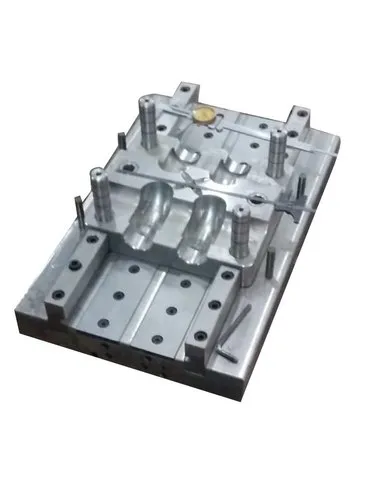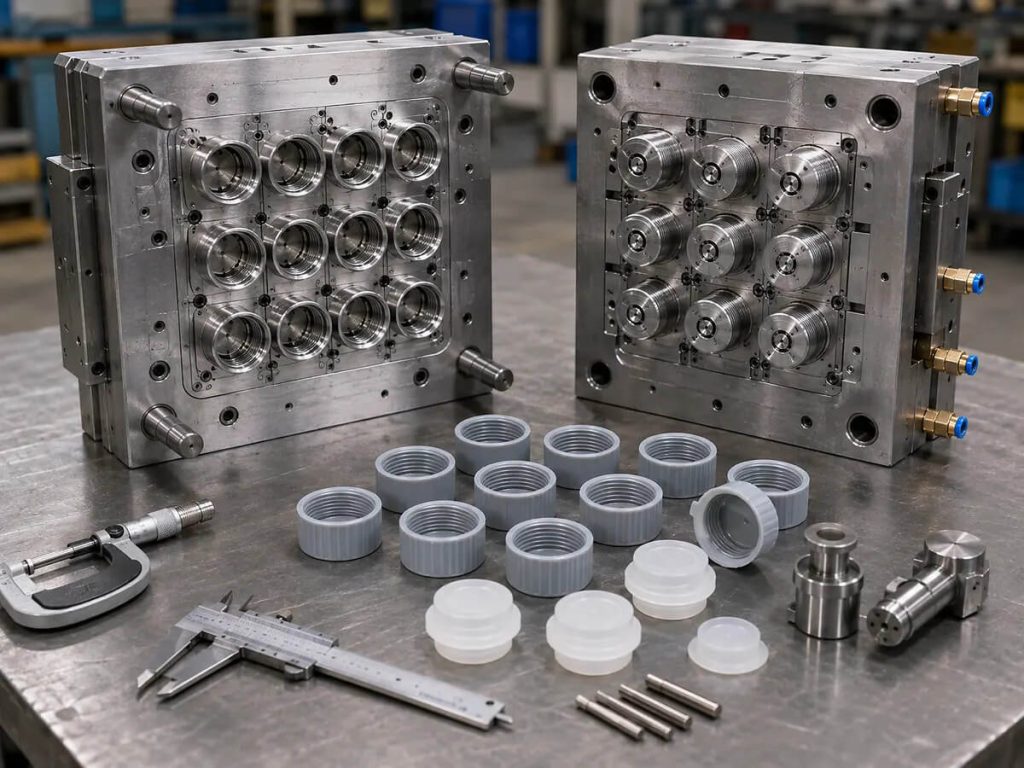
Unscrewing injection moulds are specialized moulding systems designed to manufacture plastic components with internal or external threads, undercuts, and other helical features that cannot be released from a conventional injection mould through simple ejection.
These moulds incorporate a mechanical, hydraulic, or servo-driven unscrewing mechanism that rotates the threaded core or cavity during mould opening. This controlled rotation allows the moulded component to be safely disengaged from the threaded section without damaging the part.
Unscrewing moulds are widely used for products such as bottle caps, threaded connectors, closures, fittings, containers, and automotive or industrial components. Depending on the application, the system can be designed with single or multiple threaded cores to support efficient multi-cavity production.
Key advantages include:
- Production of complex threaded components with high dimensional accuracy
- Controlled and reliable thread release
- Reduced risk of part damage during ejection
- Suitable for high-volume production
- Compatibility with automated moulding processes
- Flexible mechanical, hydraulic, or servo-driven unscrewing systems
- Improved repeatability and moulding efficiency
The design of an unscrewing injection mould requires careful consideration of thread geometry, core rotation, pitch, mould opening sequence, cooling, lubrication, ejection, and cycle time. Proper synchronization between the unscrewing mechanism and mould movements is essential for reliable operation and long mould life.