1. Introduction
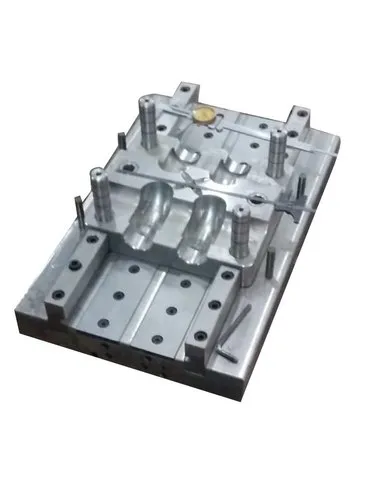
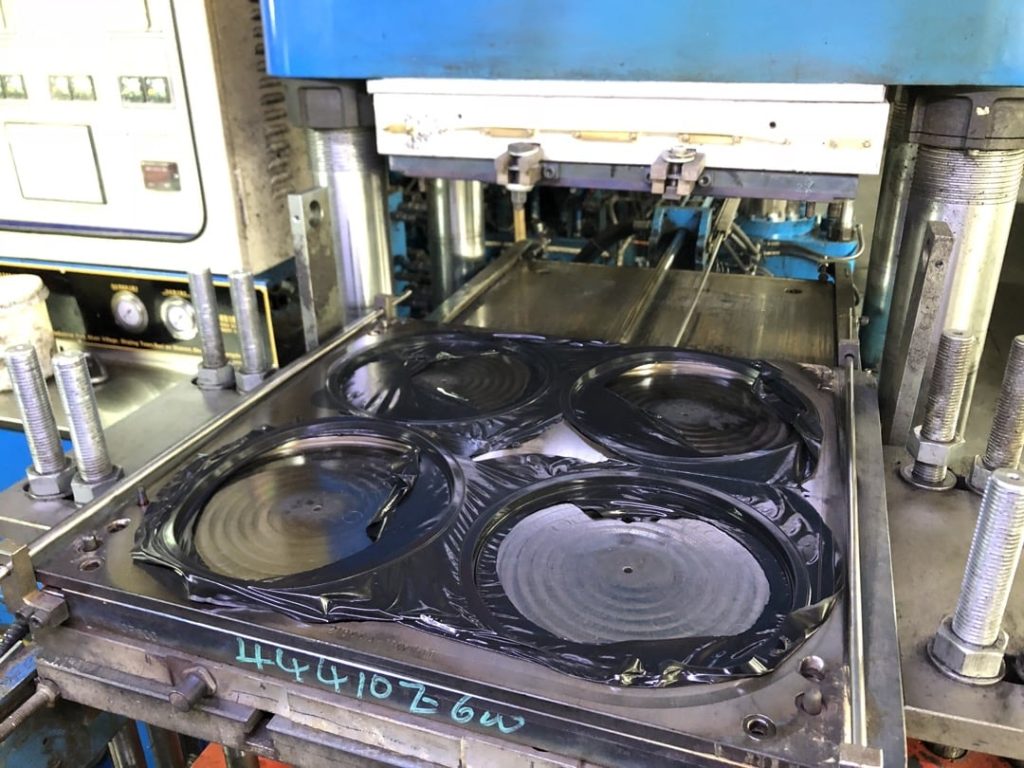
Compression moulding is a manufacturing process in which a measured quantity of moulding material is placed into a heated mould cavity. The mould is then closed, and pressure is applied to force the material to flow, fill the cavity, and take the shape of the mould. Depending on the material, heat and pressure also cause curing or consolidation, producing a finished component.
Pressure is one of the most important process parameters in compression moulding. The correct pressure ensures complete cavity filling, proper material flow, good surface finish, dimensional accuracy, and adequate mechanical properties.
The pressure requirement depends on the type of moulding material, mould temperature, component geometry, charge quantity, curing characteristics, and size of the moulded part.
2. Definition of Pressure in Compression Moulding
Pressure in compression moulding is the force applied by the press to the moulding material through the mould surfaces.
It can be expressed as:
\[ \boxed{P=\frac{F}{A}} \]
Where:
- \(P\) = Pressure applied to the moulding material
- \(F\) = Applied compressive force
- \(A\) = Projected area over which the force acts
Pressure is commonly expressed in pascals (Pa), megapascals (MPa), or bar.
Useful conversions:
- \(1\text{ MPa}=1\text{ N/mm}^2\)
- \(1\text{ MPa}=10\text{ bar}\)
- \(1\text{ bar}=0.1\text{ MPa}\)
For example, if a force of 500 kN acts over a projected area of \(250\text{ cm}^2\), the average pressure is:
\[ A=250\times100=25{,}000\text{ mm}^2 \]
\[ P=\frac{500{,}000}{25{,}000} =20\text{ MPa} \]
Therefore, the average pressure over the projected area is 20 MPa, equivalent to 200 bar.
This is a simplified calculation. The pressure experienced by the material may vary throughout the cavity, and the hydraulic pressure indicated by a press gauge is not necessarily the same as the pressure acting on the moulding material.
3. Importance of Pressure in Compression Moulding
Pressure performs several essential functions during the moulding process.
3.1 Filling the Mould Cavity
Pressure forces the softened or deformable material to flow into the mould cavity, including corners, recesses, and other features.
Insufficient pressure may result in incomplete filling or short shots.
3.2 Removing Air and Volatile Products
Appropriate pressure, together with suitable mould venting and controlled mould closure, helps air escape from the cavity.
In thermosetting materials, gases or volatile substances may be released during curing. If they cannot escape, they may cause porosity, blisters, or internal voids.
3.3 Improving Surface Finish
Correct pressure promotes contact between the moulding material and the mould surfaces. This helps reproduce surface details and can reduce surface irregularities.
3.4 Achieving Dimensional Accuracy
Suitable pressure helps the material conform to the mould geometry. However, dimensional accuracy also depends on temperature, shrinkage, material flow, cure, and cooling conditions.
3.5 Improving Product Strength
Appropriate pressure can improve consolidation, reduce voids, and promote uniform material distribution. Excessive pressure, however, may damage reinforcement or cause other defects.
3.6 Maintaining Mould Closure
The press must provide sufficient force to keep the mould closed against the pressure generated within the cavity. This helps prevent unwanted material leakage or flash.
4. Typical Pressure Requirements for Different Materials
Pressure requirements vary significantly according to the material formulation and the type of compression moulding process.
The following values are illustrative starting ranges for preliminary understanding, not universal production settings. Actual requirements should be obtained from material supplier recommendations, mould design specifications, and validated process trials.
| Material or process | Illustrative moulding pressure |
|---|---|
| Rubber compounds | Approximately 3–15 MPa |
| Phenolic moulding compounds | Approximately 10–35 MPa |
| Conventional thermosetting compounds | Approximately 10–40 MPa |
| Sheet moulding compound (SMC) | Approximately 5–15 MPa |
| Bulk moulding compound (BMC) | Approximately 10–30 MPa |
| Thermoplastic compression moulding | Highly variable; often approximately 1–20 MPa |
These ranges overlap and should not be treated as fixed limits. Some applications operate outside them, depending on the material, component thickness, reinforcement, mould configuration, and required properties.
For example, a low-viscosity material may fill a cavity at a relatively low pressure, whereas a highly viscous compound or a complex, thin-walled component may require greater pressure.
5. Factors Affecting Pressure Requirements
5.1 Type of Material
Different materials have different flow characteristics and curing mechanisms.
- Thermosetting plastics: Require suitable pressure and heat to fill the cavity and remain in contact with the mould during curing.
- Thermoplastics: Require pressure appropriate to their temperature-dependent flow and consolidation behavior.
- Rubber: Requires sufficient pressure to distribute the compound and form the required geometry during vulcanization.
- Fiber-reinforced compounds: Require pressure that consolidates the material without causing unacceptable fiber movement or damage.
5.2 Mould Temperature
Temperature affects material viscosity, flow, and curing rate.
When a material becomes more fluid as temperature increases, it may require less pressure to fill the cavity. However, excessive temperature can cause premature curing in thermosets or thermal degradation in sensitive materials.
Pressure and temperature must therefore be optimized together.
5.3 Component Geometry
Component geometry strongly influences the required pressure.
- Thin sections may resist flow and require careful pressure control.
- Deep cavities may require suitable charge placement and flow paths.
- Complex shapes may require more uniform material distribution.
- Large flat components may require careful control of pressure distribution to prevent warpage.
5.4 Charge Quantity
The charge is the measured quantity of material placed into the mould before closing.
An insufficient charge may produce incomplete filling, regardless of the applied pressure. An excessive charge can cause excessive flash, increased press loads, or material overflow.
Correct charge weight and placement are therefore essential.
5.5 Material Viscosity
Viscosity describes a material’s resistance to flow.
Higher-viscosity materials generally require greater pressure or more favorable processing conditions to flow through restricted sections. Material viscosity may change significantly with temperature, time, and the progress of curing.
5.6 Mould Design and Venting
Poorly positioned vents, restricted flow paths, and unsuitable cavity geometry can increase the pressure needed for filling.
Effective venting allows air and gases to escape, reducing the risk of trapped-air defects.
5.7 Reinforcement Content
Glass fibers, mineral fillers, and other reinforcements affect flow and consolidation.
A highly filled or reinforced compound may require different pressure conditions from an unfilled resin. Excessive pressure or unsuitable flow conditions can also disturb fiber orientation or damage some reinforcement structures.
5.8 Curing or Cooling Time
Pressure must be maintained for an appropriate period while the material cures or consolidates.
Releasing pressure too early can result in incomplete curing, dimensional changes, voids, or loss of shape. The correct holding period depends on the material and component thickness.
6. Types of Pressure Used During the Process
Pressure can be considered in terms of the stages of the moulding cycle.
6.1 Initial Closing Pressure
This is the pressure applied as the mould begins to close and the material starts to deform or flow.
The initial closing action must be controlled so that the material distributes appropriately and air can escape.
6.2 Moulding Pressure
This is the pressure applied to the material to fill the cavity and consolidate it into the required shape.
It is the principal process pressure considered when specifying compression moulding conditions.
6.3 Holding Pressure
Holding pressure is maintained after the material has filled the cavity, where required by the process.
Its purpose is to maintain contact with the mould surfaces and support consolidation or curing until the component can retain its shape.
6.4 Clamping Force
Clamping force is the total force used to keep the mould halves closed.
It must be sufficient to resist the separating forces generated by cavity pressure. If it is insufficient, the mould may open slightly and produce flash.
Clamping force and material pressure are related but are not the same quantity.
7. Calculation of Press Force
The required press force can be estimated using the relationship:
\[ \boxed{F=P\times A} \]
Where:
- \(F\) = Required force in newtons
- \(P\) = Design pressure in pascals
- \(A\) = Projected area in square metres
When pressure is expressed in MPa and area in \(\text{mm}^2\), the calculation becomes:
\[ \boxed{F(\text{kN})= \frac{P(\text{MPa})\times A(\text{mm}^2)}{1000}} \]
Example calculation
Suppose a compression moulding operation has the following parameters:
- Projected moulded area = \(400\text{ cm}^2\)
- Required average moulding pressure = \(15\text{ MPa}\)
Step 1: Convert the area.
\[ 400\text{ cm}^2=40{,}000\text{ mm}^2 \]
Step 2: Calculate the force.
\[ F=15\times40{,}000 =600{,}000\text{ N} \]
Step 3: Convert the force to kilonewtons.
\[ F=600\text{ kN} \]
Therefore, the idealized force corresponding to the specified pressure and projected area is 600 kN, equivalent to approximately 61.2 metric tonnes-force.
In practical press selection, additional considerations include the number of cavities, pressure distribution, mould stiffness, machine capacity, and a suitable engineering margin. The calculation alone does not establish a safe or validated operating setting.
8. Effects of Insufficient and Excessive Pressure
| Condition | Possible effects |
|---|---|
| Insufficient pressure | Incomplete filling, poor surface finish, voids, weak consolidation, dimensional inconsistencies |
| Excessive pressure | Excessive flash, mould overload, reinforcement damage, material displacement, increased wear |
| Uneven pressure distribution | Variable thickness, incomplete local filling, uneven surface quality, warpage |
| Pressure released too early | Incomplete consolidation or cure, dimensional instability, loss of shape |
It is important to remember that not every defect is caused by pressure alone. Temperature, charge quantity, venting, material condition, and mould design must also be checked.
9. Pressure Control in Compression Moulding
Pressure should be controlled according to the requirements of the material and the moulding cycle.
Common control methods include:
- Hydraulic press control: Hydraulic systems provide the force required to close the mould and compress the material.
- Pressure monitoring: Press force, hydraulic pressure, and other process variables are monitored to maintain repeatable operating conditions.
- Controlled mould closure: The mould is closed at an appropriate speed to help distribute material and allow air to escape.
- Pressure holding: The specified load is maintained during the required consolidation or curing period.
- Process validation: Trial runs and inspection confirm that the selected pressure produces acceptable parts.
A hydraulic pressure gauge measures fluid pressure within the hydraulic system. Converting that reading into press force requires the machine’s effective hydraulic piston area and, where relevant, the system’s mechanical characteristics.
10. Difference Between Compression Moulding Pressure and Injection Moulding Pressure
| Feature | Compression moulding | Injection moulding |
|---|---|---|
| Material introduction | Charge placed directly into an open or partially open mould | Melt injected through a nozzle and runner system |
| Main pressure function | Compresses and distributes material in the cavity | Drives the melt through the injection flow path and packs the cavity |
| Pressure requirements | Depends on material flow, charge distribution, and consolidation | Depends on melt viscosity, flow length, gate design, and packing requirements |
| Pressure application | Primarily through mould closure and press force | Primarily through the injection unit, with clamping force resisting cavity separation |
| Typical equipment | Compression press and heated mould | Injection moulding machine and injection mould |
The pressure values used for these processes should not be compared without considering how each machine measures pressure and how the force is transmitted to the material.
11. Practical Recommendations
For reliable compression moulding, the following practices are recommended:
- Follow the material supplier’s processing guidelines.
- Determine the correct charge weight and placement.
- Select an appropriate mould temperature.
- Establish a suitable pressure profile through controlled trials.
- Ensure that the mould has effective venting.
- Maintain pressure for the required curing or consolidation time.
- Inspect components for flash, voids, incomplete filling, and dimensional defects.
- Confirm that the press and mould can safely withstand the required forces.
- Record validated settings to maintain production consistency.
12. Conclusion
Pressure is a fundamental process parameter in compression moulding. It forces the material to flow into the mould cavity, promotes contact with the mould surfaces, supports consolidation, and helps produce components with the required shape and quality.
The required pressure depends on the material, component geometry, mould temperature, charge quantity, viscosity, reinforcement content, and curing or cooling conditions.