High-Performance Plastics in Automotive Components
Introduction
The automotive industry is continuously evolving to meet demands for lighter, stronger, and more fuel-efficient vehicles. High-performance plastics (HPPs) have become a crucial part of this evolution, offering superior properties compared to conventional materials like metals and standard polymers. These plastics enable engineers to design components that are lighter, more durable, and resistant to harsh operating conditions.
What are High-Performance Plastics?
High-performance plastics are a class of polymer materials that maintain their mechanical, thermal, and chemical stability even under extreme conditions. Unlike standard plastics such as polypropylene (PP) or polyethylene (PE), HPPs can withstand high temperatures, mechanical stress, and exposure to automotive fluids without degrading.
Common types of high-performance plastics used in automobiles include:
Polyetheretherketone (PEEK)
Polyphenylene sulfide (PPS)
Polyamide-imide (PAI)
Polysulfone (PSU)
Polyethersulfone (PES)
Polyamide (Nylon 6, 6/6, 12)
Polybutylene terephthalate (PBT)
Polyoxymethylene (POM)
Key Properties
High-performance plastics offer several advantages that make them ideal for automotive applications:
Lightweight: Up to 50% lighter than metals, improving fuel efficiency and range in electric vehicles.
High Temperature Resistance: Capable of withstanding temperatures above 200°C.
Chemical Resistance: Excellent resistance to oils, fuels, and coolants.
Dimensional Stability: Maintains shape and strength under mechanical stress.
Corrosion and Wear Resistance: Reduces the need for maintenance and extends component lifespan.
Design Flexibility: Allows complex shapes and integrated functions through precision moulding.
Applications in Automotive Components
High-performance plastics are used in a variety of functional and structural automotive parts:
1. Engine and Powertrain Components
Intake manifolds
Fuel system parts (connectors, pumps, and valves)
Turbocharger housings
Gaskets and seals
Transmission components
2. Electrical and Electronic Systems
Connectors, housings, and fuse boxes
Sensor casings and relay components
Battery enclosures and EV power modules
3. Interior and Exterior Parts
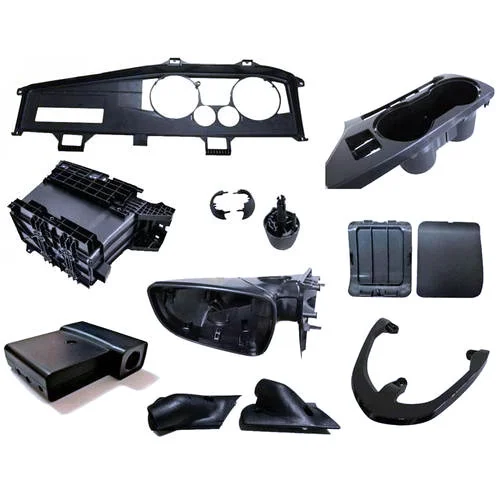
Dashboard supports and trim components
Door handles and mirror housings
Lightweight structural frames and panels
4. Under-the-Hood Applications
Cooling system parts (thermostat housings, water pumps)
Air ducts and fluid reservoirs
Heat shields and brackets
Benefits to the Automotive Industry
Weight Reduction: Directly contributes to lower fuel consumption and emissions.
Enhanced Performance: Improves reliability under high heat and mechanical stress.
Sustainability: Many HPPs are recyclable and support eco-friendly manufacturing.
Cost Efficiency: Reduces manufacturing steps through integrated moulding.
Design Innovation: Enables compact and multifunctional component designs.
Challenges and Future Trends
Challenges:
Higher raw material and processing costs
Complex recycling processes
Limited availability of some HPP grades
Future Trends:
Increased use in electric vehicles (EVs) for lightweighting and insulation.
Development of bio-based high-performance polymers.
Hybrid metal-plastic structures combining strength and weight advantages.
Adoption of 3D printing with HPPs for rapid prototyping and customization.
Conclusion
High-performance plastics have revolutionized automotive engineering by enabling lighter, safer, and more efficient vehicles. As the industry shifts toward electric and sustainable mobility, the role of these advanced materials will continue to expand—shaping the future of automotive design and manufacturing.