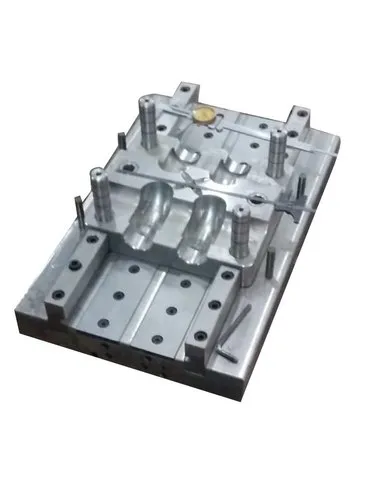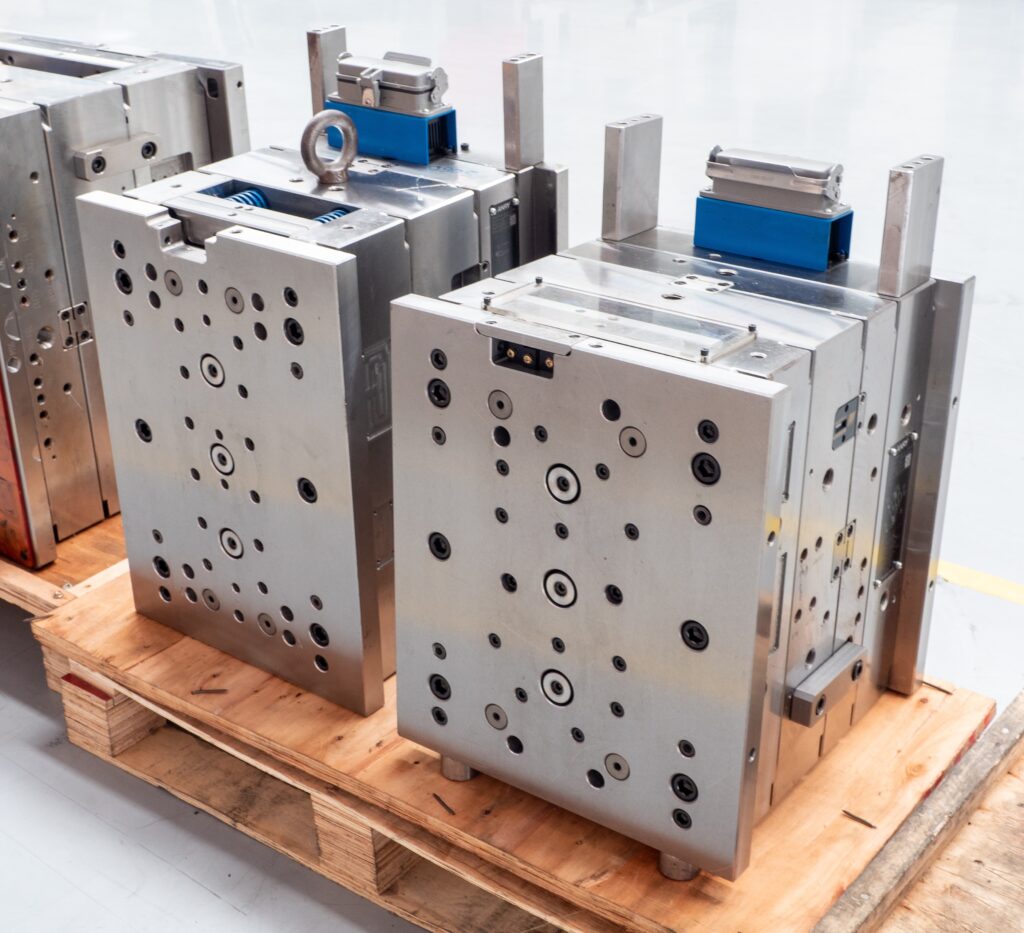
A multi-cavity injection mould is an injection mould that contains two or more cavities, allowing multiple plastic parts to be produced during a single injection cycle. It is commonly used for medium- and high-volume production where increased output and consistent part quality are important.
How Does a Multi-Cavity Mould Work?
The basic process is:
1. Mould Closing
The mould closes, bringing the core and cavity sections together.
2. Plastic Injection
Molten plastic enters the mould through the sprue and runner system.
3. Material Distribution
The runner system distributes the molten plastic to the individual cavities.
4. Filling and Packing
Each cavity is filled and packed with the required amount of material.
5. Cooling
Cooling channels remove heat while the plastic solidifies.
6. Mould Opening and Ejection
The mould opens and the ejector system removes the molded parts.
Several identical parts are therefore produced in one cycle.
Main Components
A multi-cavity injection mould typically includes:
- Multiple cavities – Form the external shape of the parts.
- Multiple cores – Form internal features.
- Sprue – Main material entry passage.
- Runner system – Distributes molten plastic to the cavities.
- Gates – Control material entry into individual cavities.
- Cooling channels – Control mould temperature.
- Ejector system – Removes the finished parts.
- Guide pins and bushes – Maintain mould alignment.
- Vents – Allow trapped air and gases to escape.
Types of Multi-Cavity Arrangements
1. Balanced Layout
The cavities are arranged so that the flow path and filling conditions are as uniform as possible.
A balanced layout can help achieve consistent filling across the cavities.
2. Family Mould
A family mould contains cavities for different related components rather than identical parts.
For example, several components of a product assembly may be molded in the same cycle.
Advantages of Multi-Cavity Injection Moulds
1. Higher Production Output
Multiple parts are produced during every cycle, increasing productivity.
2. Lower Cycle Cost per Part
When production volumes are sufficiently high, the machine cycle is shared across multiple parts.
3. Consistent Parts
Identical cavities can produce multiple parts under the same process conditions.
4. Efficient High-Volume Production
Multi-cavity moulds are particularly useful when large quantities of the same component are required.
5. Better Machine Utilization
More parts can be produced from each machine cycle.
Limitations
- Higher mould manufacturing cost
- More complex mould design
- More complicated runner and cooling systems
- Cavity-to-cavity filling must be carefully controlled
- Maintenance can be more involved
- Imbalance between cavities can cause variations in part quality
Single-Cavity vs. Multi-Cavity
| Feature | Single-Cavity | Multi-Cavity |
|---|---|---|
| Parts per cycle | 1 | 2 or more |
| Production output | Lower | Higher |
| Tooling complexity | Generally simpler | Generally more complex |
| Initial tooling investment | Generally lower | Generally higher |
| Flow balancing | Simple | Important |
| Suitable production | Low-volume/prototypes | Medium- to high-volume |
Important Design Considerations
When designing a multi-cavity mould, engineers need to consider:
- Number of cavities
- Cavity layout
- Runner and gate design
- Flow balance
- Cooling system
- Ejection system
- Mould material
- Machine capacity
- Part tolerances
- Expected production volume
In Short
Multi-cavity injection moulds produce multiple plastic parts in a single injection cycle. They are especially useful for high-volume manufacturing because they can significantly increase production output and reduce the effective processing cost per part. Proper cavity layout, flow balancing, cooling, and ejection design are essential for consistent results.