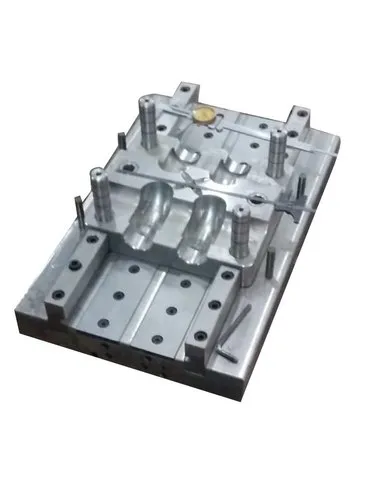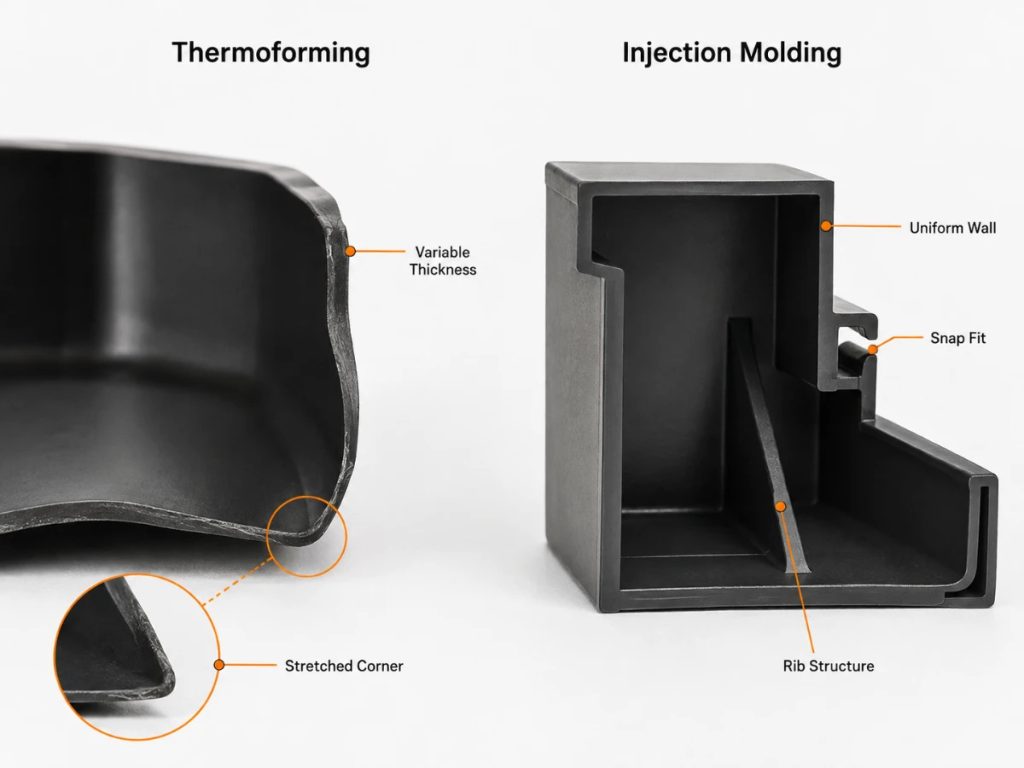
Parting line design is an important aspect of thermoforming mould development that determines the location where the mould separates to release the formed plastic component. The parting line is the boundary between the mating sections of a mould, typically the upper and lower mould halves. Proper parting line placement helps ensure easy demoulding, accurate component geometry, minimal flash, and a high-quality surface finish.
In the thermoforming process, a heated plastic sheet is formed over or into a mould using vacuum, pressure, or mechanical assistance. Once the material has cooled sufficiently, the mould is opened and the formed component is removed. A carefully designed parting line allows the component to separate smoothly from the mould while minimizing deformation, unwanted marks, and material damage.
Parting line design is widely used in the development of thermoformed packaging trays, food containers, automotive interior panels, plastic housings, protective covers, and industrial plastic components.
Key Advantages of Proper Parting Line Design
- Easy Part Removal: Facilitates smooth separation of the thermoformed component from the mould.
- Improved Surface Finish: Minimizes visible parting marks, scratches, and surface imperfections.
- Dimensional Accuracy: Helps maintain the required component geometry and dimensional tolerances.
- Reduced Material Deformation: Minimizes stretching, distortion, and damage during demoulding.
- Improved Mould Life: Reduces unnecessary friction, mechanical stress, and wear on mould surfaces.
- Efficient Production: Supports reliable demoulding and consistent production cycles.
- Reduced Trimming Requirements: Helps optimize the flange and trim areas to minimize excess material and finishing work.
Key Design Considerations
- Part Geometry: Select a parting line location that accommodates the overall component shape, depth, and surface features.
- Draft Angles: Incorporate suitable draft angles on vertical walls and other relevant surfaces to facilitate smooth component release.
- Mould Separation: Ensure that the mould sections can open without interfering with the formed component.
- Surface Appearance: Position the parting line away from prominent visible areas whenever practical to maintain the required appearance.
- Material Thickness: Consider material stretching and thinning near the parting line to maintain adequate wall thickness.
- Trimming Allowance: Provide sufficient flange and trimming areas to support accurate and consistent finishing operations.
- Vacuum and Venting: Position vacuum holes and venting features appropriately to ensure effective material forming without compromising the parting line.
- Mould Alignment: Maintain accurate alignment between mating mould sections to prevent unwanted marks, gaps, and dimensional inconsistencies.
- Undercut Management: Identify undercuts and incorporate suitable mould-release features or alternative mould configurations where necessary.
Common Parting Line Design Approaches
- Straight Parting Line: Used for relatively simple components with uncomplicated geometries and mould separation requirements.
- Stepped Parting Line: Suitable for components with varying heights or complex geometries where a single flat separation plane is not practical.
- Contoured Parting Line: Follows the component profile and is used for moulds with curved or irregular geometries.
- Flange-Based Parting Line: Positioned around the flange or trim region to support component release and subsequent trimming.
Importance of Parting Line Design in Thermoforming
An incorrectly positioned parting line can lead to difficult demoulding, component distortion, surface marks, inconsistent trimming, and increased production waste. It can also complicate mould manufacturing, alignment, and maintenance.
A properly designed parting line should consider the forming direction, mould configuration, component geometry, material behavior, draft angles, and trimming requirements. Early consideration of these factors during mould development helps reduce design modifications and improve production reliability.
Effective parting line design provides smooth demoulding, improved dimensional accuracy, consistent surface quality, reduced material waste, and enhanced thermoforming efficiency, contributing to reliable and cost-effective manufacturing.