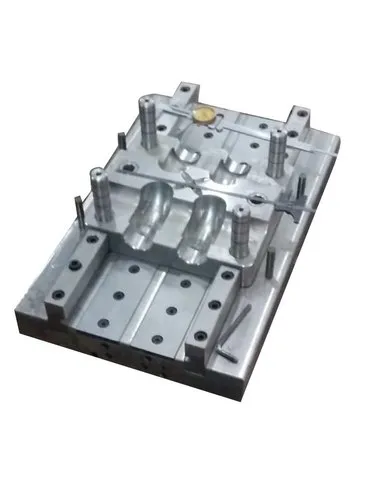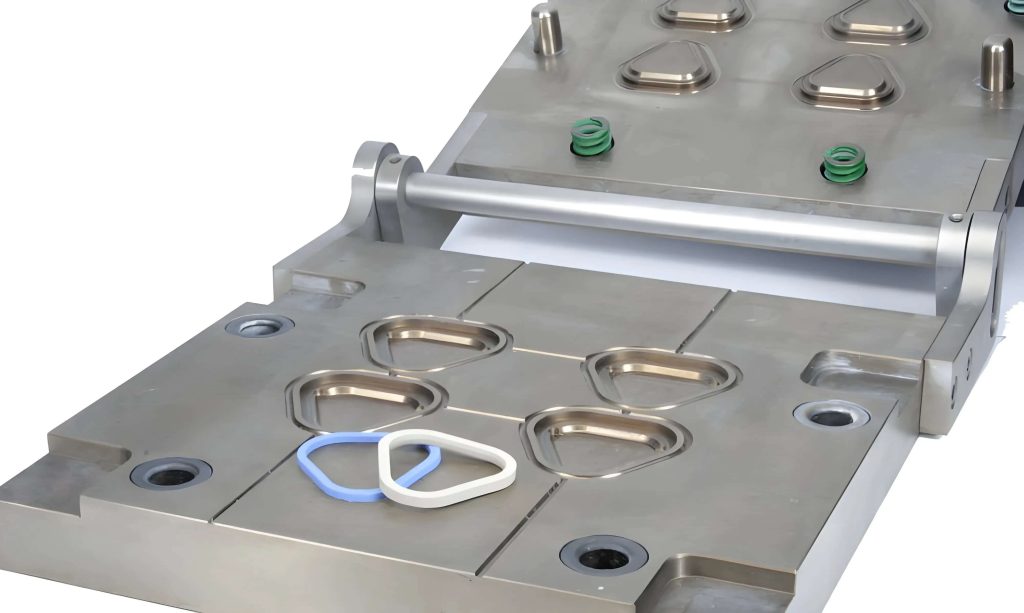
Semi-positive compression moulds are a type of compression moulding tool that combines features of positive and flash-type compression moulds. They use a relatively close-fitting punch and cavity to control the flow of moulding material while still allowing a limited amount of excess material to escape through a controlled clearance or flash area.
During the moulding process, a measured quantity of material is placed into the heated mould cavity. As the mould closes, the punch applies pressure and forces the material to flow throughout the cavity. The controlled clearance between the mould components permits a limited amount of excess material to escape, helping achieve complete cavity filling while controlling flash formation.
Semi-positive compression moulds are commonly used for thermoset plastic components, electrical parts, automotive components, industrial products, appliance parts, and rubber or composite components.
Key Advantages
- Controlled Material Flow: Provides better control over material movement compared with conventional flash-type moulds.
- Reduced Flash: Produces less flash than standard flash-type compression moulds.
- Good Dimensional Accuracy: Provides improved control of component dimensions and material thickness.
- Effective Cavity Filling: Allows limited excess material to escape, helping prevent excessive pressure and incomplete filling.
- Reduced Material Waste: Uses a controlled material charge and limits unnecessary flash formation.
- Improved Surface Finish: Supports consistent moulding and good surface quality.
- Versatile Operation: Suitable for a broad range of thermoset and composite moulding applications.
Key Design Considerations
- Punch-to-Cavity Clearance: The clearance must be accurately controlled to regulate material flow and flash formation.
- Material Charge: The correct quantity of material should be used to achieve complete cavity filling without excessive flash.
- Compression Pressure: Sufficient pressure must be applied to ensure proper material flow and consolidation.
- Mould Temperature: Uniform heating is essential for consistent material flow and curing.
- Venting: Proper vents should be provided to allow trapped air and gases to escape.
- Mould Alignment: Accurate alignment between the punch and cavity helps prevent uneven wear, flash, and dimensional variations.
- Ejection System: The mould should incorporate a reliable ejection system that removes the cured component without damage.
- Wear Resistance: The mould should be manufactured from suitable materials capable of withstanding repeated pressure and temperature cycles.
Applications
- Electrical insulation components
- Automotive parts
- Thermoset plastic housings
- Industrial components
- Appliance components
- Rubber and composite parts
- Precision moulded products
Importance of Semi-Positive Compression Mould Design
The main objective of a semi-positive compression mould is to achieve a balance between controlled material flow and manageable flash formation. Unlike a fully positive mould, it provides some allowance for excess material, reducing the risk of excessive moulding pressure. At the same time, its controlled clearances provide better flash control than a conventional flash-type mould.
A properly designed semi-positive compression mould provides good dimensional accuracy, controlled flash, efficient material utilization, reliable cavity filling, and consistent component quality, making it a practical choice for applications requiring a balance between precision and production flexibility.