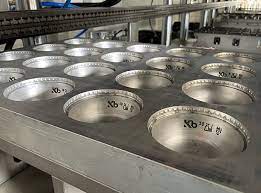
Thermoforming is a manufacturing process in which a plastic sheet is heated to a pliable forming temperature, shaped into a specific form using a mould, and trimmed to create a usable product. It is widely used in packaging, automotive components, medical devices, and consumer products due to its cost-effectiveness and adaptability.
A key part of the thermoforming process is the die and mould base, which determine the shape, accuracy, and quality of the final product.
Thermoforming Dies
A die in thermoforming refers to the tool or component that shapes the heated plastic sheet into the desired form. There are different types of dies used depending on the application and complexity of the part being produced.
Types of Thermoforming Dies:
Male Die (Positive Mould):
The heated plastic sheet is formed over the protruding die.
Commonly used for shallow and symmetrical parts.
Provides better definition on the exterior of the product.
Female Die (Negative Mould):
The plastic sheet is drawn into a cavity.
Suitable for deeper or more complex parts.
Offers finer detail on the inside surface of the product.
Matched Die:
Combines both male and female dies to sandwich the sheet for precise forming.
Used for high-precision applications.
Vacuum and Pressure Dies:
Vacuum forming uses suction to pull the sheet into or over the mould.
Pressure forming uses additional air pressure for more detailed and high-quality parts.
Materials Used for Thermoforming Dies:
Aluminum: Lightweight, good thermal conductivity, suitable for high-volume production.
Steel: Durable and suitable for long runs and detailed work.
Epoxy or Urethane Resin: Used for prototype or low-volume production; less expensive.
Wood or MDF: Typically used for prototype or temporary tooling.
Mould Bases in Thermoforming
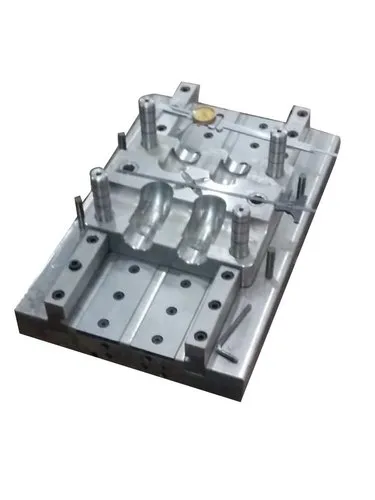
A mould base is the foundational structure that holds and supports the die or mould. It ensures alignment, structural integrity, and repeatability during the thermoforming process.
Functions of a Mould Base:
Provides structural support for the die.
Aligns and secures the mould components.
Integrates with the thermoforming machine’s mechanical and thermal systems.
Houses channels for vacuum, pressure, and cooling lines.
Components of a Mould Base:
Base Plate: The main supporting plate where dies are mounted.
Guide Pillars and Bushings: Ensure precise alignment between mould parts.
Cooling Channels: Help regulate temperature during forming.
Vacuum Ports and Manifolds: Facilitate even distribution of vacuum.
Materials for Mould Bases:
Steel and Aluminum: Most common for durability and machining precision.
Composite Materials: Used for lighter-duty applications or where weight is a concern.
Importance of Precision in Dies and Mould Bases
Precision in die design and mould base construction is crucial for:
Consistent product quality.
Minimal material waste.
Efficient cycle times.
Accurate fit and finish of formed parts.
Advanced CAD/CAM software and CNC machining are typically employed to achieve the necessary precision in manufacturing these components.
Conclusion
Thermoforming dies and mould bases are essential components that directly impact the efficiency, quality, and cost-effectiveness of thermoformed products. Choosing the right die type and mould base material, along with precise manufacturing and maintenance, ensures a successful and productive thermoforming operation.