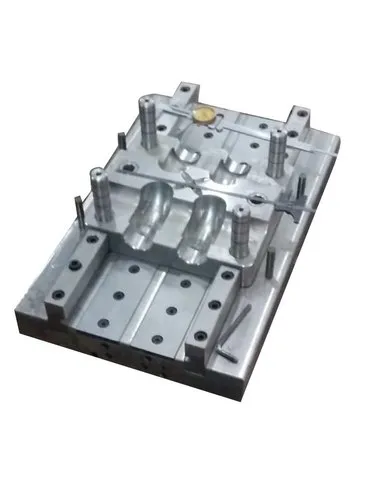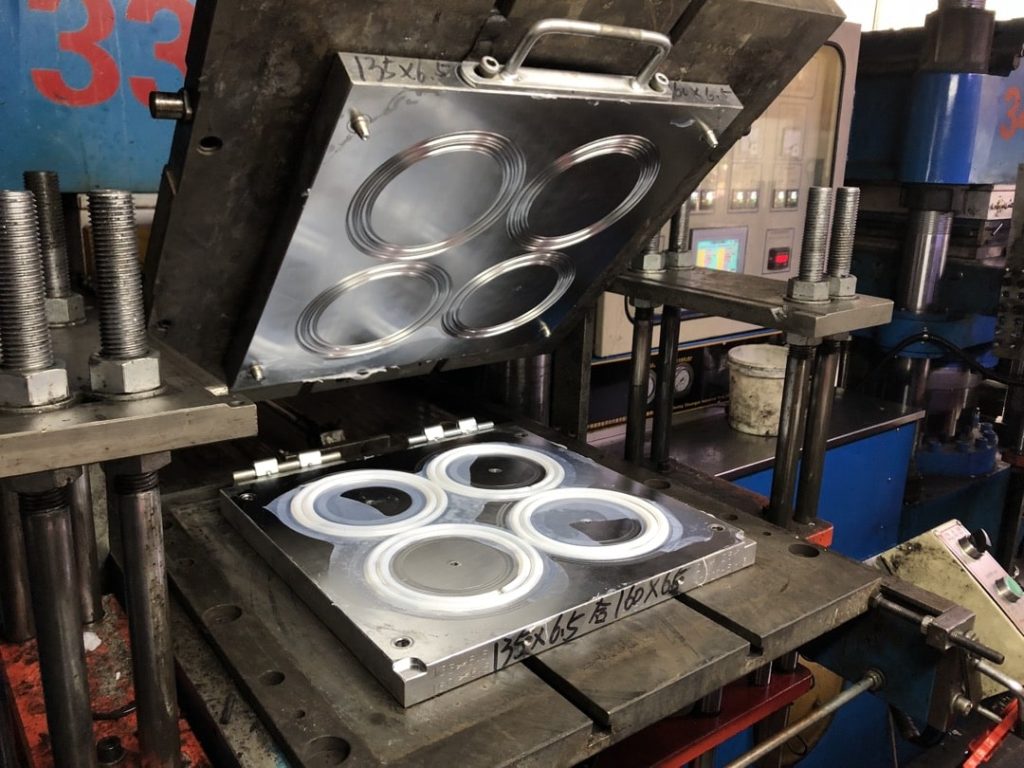
Rubber Compression Moulding is a manufacturing process used to produce rubber components by placing a measured quantity of rubber compound into a heated mould and applying pressure until the material takes the shape of the mould and cures.
It is widely used for manufacturing seals, gaskets, O-rings, rubber pads, bushings, diaphragms, and other flexible components.
What Is Rubber Compression Moulding?
In this process, an uncured rubber compound, called a rubber charge, is placed directly into the mould cavity. The mould is then closed and heated under pressure.
The heat causes the rubber to undergo vulcanization or curing, transforming it from a soft, uncured material into a stable elastic product.
Rubber Compression Moulding Process
The basic process consists of the following steps:
1. Rubber Preparation
The rubber compound is mixed with ingredients such as curing agents, accelerators, fillers, pigments, and other additives.
2. Charge Preparation
A specific quantity of rubber is measured and prepared according to the mould and product requirements.
3. Mould Preparation
The mould is cleaned and, when required, a suitable mould-release agent is applied.
4. Loading
The prepared rubber charge is placed into the heated mould cavity.
5. Mould Closing
The upper mould section closes over the rubber charge.
6. Compression
Pressure forces the rubber to flow and fill the cavity.
7. Heating and Curing
Heat and pressure are maintained for a specified period. The rubber cures and develops its required physical properties.
8. Mould Opening
After sufficient curing, the mould is opened.
9. Part Removal
The finished rubber component is removed, often using ejector mechanisms or manually.
10. Trimming and Inspection
Excess rubber, known as flash, is removed and the component is inspected.
Main Components of a Rubber Compression Mould
| Component | Function |
|---|---|
| Upper Plate | Compresses the rubber charge |
| Lower Plate | Supports the mould cavity |
| Cavity | Forms the external shape |
| Core | Creates internal features |
| Guide Pins | Maintain mould alignment |
| Heating System | Provides curing temperature |
| Ejector System | Helps remove the finished part |
| Vents | Allow trapped air and gases to escape |
| Flash Land | Controls excess rubber around the part |
Types of Rubber Commonly Used
Different rubber compounds can be processed using compression moulding, depending on the application.
- Natural Rubber (NR) – Good elasticity and mechanical strength
- Silicone Rubber – Excellent temperature resistance and flexibility
- EPDM – Good weather, ozone, and water resistance
- Nitrile Rubber (NBR) – Good resistance to oils and fuels
- Neoprene (CR) – Good weathering and chemical resistance
- Butyl Rubber (IIR) – Good air and gas impermeability
- Fluoroelastomers (FKM) – Excellent chemical and high-temperature resistance
The appropriate rubber compound depends on the product’s operating environment.
Advantages of Rubber Compression Moulding
- Suitable for large and relatively thick rubber components
- Tooling can be simpler than some other rubber moulding methods
- Suitable for low- to medium-volume production
- Can process many different rubber compounds
- Good for producing customized shapes
- Relatively low material waste compared with some processes
- Suitable for products with complex cross-sections
Limitations
- Generally slower than highly automated injection moulding.
- Loading and unloading can require more labor.
- Flash may need to be trimmed.
- Cycle time depends significantly on curing requirements.
- Dimensional consistency can depend on charge preparation and mould control.
- Not always economical for very high-volume production.
Rubber Compression Moulding vs. Rubber Injection Moulding
| Feature | Compression Moulding | Injection Moulding |
|---|---|---|
| Material Loading | Directly into cavity | Injected into cavity |
| Tooling | Relatively simple | More complex |
| Production Speed | Moderate | Generally higher |
| Automation | Moderate | High |
| Material Waste | Generally low | Can be low with optimized systems |
| Suitable Production | Low to medium volume | Medium to high volume |
| Large Parts | Well suited | Depends on equipment |
| Initial Tooling Cost | Generally lower | Generally higher |
Applications
Rubber compression moulding is commonly used for:
- Rubber gaskets
- Seals
- O-rings
- Vibration-isolation pads
- Bushings
- Rubber washers
- Electrical insulation components
- Automotive rubber parts
- Industrial seals
- Medical and laboratory components
- Appliance components
- Flexible protective covers
Important Process Parameters
The quality of a rubber compression-moulded component depends on several parameters:
Temperature: The mould must reach the appropriate curing temperature for the rubber compound.
Pressure: Sufficient pressure is needed to fill the cavity and produce the desired shape.
Cure Time: Insufficient curing can result in poor mechanical properties, while excessive curing can affect productivity and properties.
Charge Weight: The amount of rubber must be carefully controlled to minimize defects and excessive flash.
Mould Design: Proper cavity design, vents, parting lines, and flash lands are important.
Cooling: Controlled cooling may be required before safe handling or demoulding.
Common Defects
Some common defects in rubber compression moulding include:
- Excessive flash
- Air traps
- Incomplete filling
- Porosity or bubbles
- Surface defects
- Under-cure
- Over-cure
- Dimensional variation
- Uneven hardness
- Poor surface finish
Proper control of rubber formulation, charge weight, temperature, pressure, curing time, and mould design helps reduce these problems.
In Short
Rubber Compression Moulding uses heat and pressure to shape and cure rubber inside a mould. It is a versatile process particularly suitable for seals, gaskets, pads, bushings, and other rubber components. Its relatively straightforward tooling and ability to handle a wide range of rubber compounds make it an important process for both industrial and consumer products.