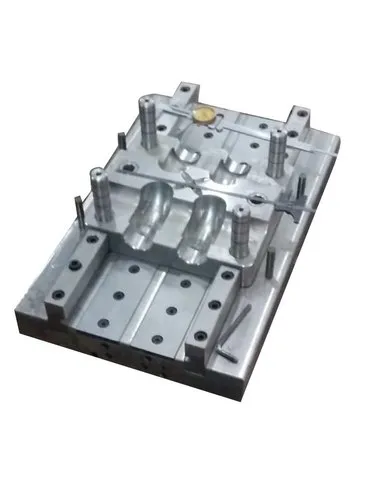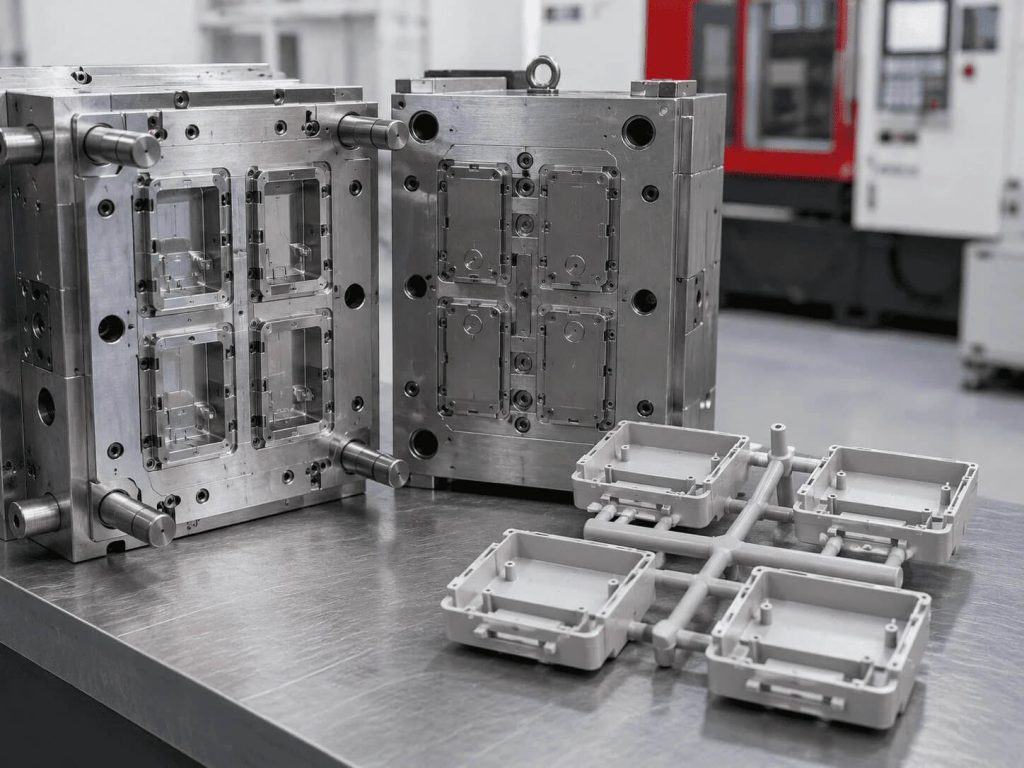
A Cold Runner Injection Mould is an injection moulding system in which the runner channels are kept at a relatively low temperature. The molten plastic passes through the sprue and runners before entering the mould cavity, and the runner material solidifies along with the moulded part.
Cold runner moulds are widely used because they are simple, reliable, and generally less expensive to manufacture than hot runner moulds.
1. What Is a Cold Runner Mould?
In a cold runner system, the plastic flows through a network of channels machined into the mould.
Basic flow:
Injection Unit → Sprue → Runner → Gate → Cavity
After injection, the plastic in the runner cools and becomes solid. During mould opening, the runner is removed together with the finished component.
2. Main Components
| Component | Function |
|---|---|
| Sprue | Carries molten plastic from the injection nozzle into the mould |
| Runner | Distributes molten plastic toward the cavities |
| Gate | Controls the entry of plastic into the cavity |
| Cavity | Forms the external shape of the product |
| Core | Forms internal features |
| Ejector System | Removes the moulded part and runner |
| Cooling Channels | Remove heat from the mould |
| Guide Pins & Bushes | Maintain accurate mould alignment |
| Vents | Allow trapped air and gases to escape |
3. How a Cold Runner Mould Works
- Plastic pellets are fed into the injection machine.
- The material is heated and melted.
- Molten plastic enters the mould through the sprue.
- The material flows through the cold runner system.
- The runner distributes plastic to the gate or gates.
- Plastic enters and fills the cavity.
- Pressure is maintained during packing.
- The plastic cools and solidifies.
- The mould opens.
- The finished part and solidified runner are ejected.
The runner is then separated from the finished product and may be recycled if the material and process allow it.
4. Types of Cold Runner Systems
A. Two-Plate Cold Runner
This is one of the most common configurations.
It generally has a single main parting line, with the sprue, runner, gate, and cavity arranged within the mould halves.
Advantages:
- Simple construction
- Lower tooling cost
- Easier maintenance
- Suitable for many general-purpose products
B. Three-Plate Cold Runner
A three-plate arrangement uses an additional mould plate and can provide greater flexibility for gate placement.
Advantages:
- Flexible gate positioning
- Can separate the runner from the moulded product automatically
- Useful for multi-cavity applications
Limitation: More complicated and expensive than a basic two-plate mould.
5. Runner Layouts
For multi-cavity moulds, runners can be arranged in different patterns.
Balanced runner system:
Runner lengths and flow paths are designed so cavities receive material at approximately similar conditions.
Unbalanced runner system:
Different flow-path lengths may be used when required by the part layout, but filling differences must be carefully considered.
A well-designed runner system helps provide consistent filling, pressure, and part quality.
6. Advantages of Cold Runner Moulds
- Lower initial tooling cost
- Simple mould construction
- Relatively easy maintenance
- Easy to understand and operate
- Suitable for many thermoplastics
- No hot runner heating system required
- Straightforward mould modifications
- Suitable for low, medium, and many high-volume applications
7. Limitations
The main disadvantage is runner waste.
Because the runner solidifies during every cycle:
- Additional plastic material is consumed.
- Runner separation may be required.
- Recycling or regrinding may be necessary.
- Cycle time can be affected by runner cooling.
- Large runner systems can increase material consumption.
For high-volume production, these factors may make a hot runner system more attractive.
8. Cold Runner vs Hot Runner
| Feature | Cold Runner | Hot Runner |
|---|---|---|
| Runner temperature | Cooled/solidifies | Heated/remains molten |
| Runner waste | Generated | Minimal |
| Tooling cost | Generally lower | Generally higher |
| Mould complexity | Lower | Higher |
| Maintenance | Simpler | More specialized |
| Heating system | Not required for runner | Required |
| Material consumption | Higher | Lower |
| Suitable for | Wide range of applications | Especially useful for high-volume production |
9. Design Considerations
When designing a cold runner mould, engineers should consider:
- Runner diameter and length
- Runner layout
- Gate type and location
- Number of cavities
- Cavity filling balance
- Material viscosity
- Injection pressure
- Cooling requirements
- Part wall thickness
- Shrinkage
- Venting
- Ejection
- Runner removal
- Regrind/recycling requirements
The runner should be large enough to allow effective filling but not unnecessarily large, because oversized runners increase material waste and cooling time.
10. Common Gate Types
Cold runner moulds can use several gate designs, including:
- Edge gate
- Submarine gate
- Pin gate
- Direct gate
- Fan gate
- Tab gate
The correct gate depends on the part geometry, material, appearance requirements, filling pattern, and production requirements.
11. Common Problems
Short shot:
The cavity does not completely fill.
Flash:
Excess plastic escapes through the parting line or another mould gap.
Weld lines:
Two or more flow fronts meet and create a visible line.
Sink marks:
Local depressions can occur because of uneven cooling or shrinkage.
Runner blockage:
Improper design, contamination, or processing conditions can restrict material flow.
Uneven cavity filling:
Poor runner balancing can cause some cavities to fill before others.
12. Applications
Cold runner injection moulds are commonly used for:
- Household plastic products
- Electrical components
- Automotive parts
- Packaging components
- Consumer products
- Industrial components
- Toys
- Plastic fittings
- General engineering parts
- Prototype and medium-volume production
In Short
A Cold Runner Injection Mould uses an unheated runner system to transport molten plastic from the injection unit to the mould cavity. The plastic inside the runner solidifies during the cycle and is removed with the finished product.
Its main strengths are simple construction, lower tooling cost, and easier maintenance. Its main limitation is runner waste, which can make hot runner moulds more economical for certain high-volume applications.