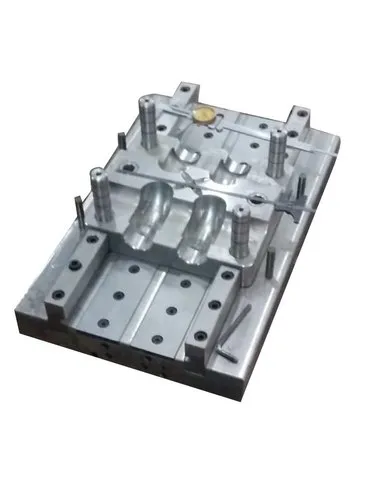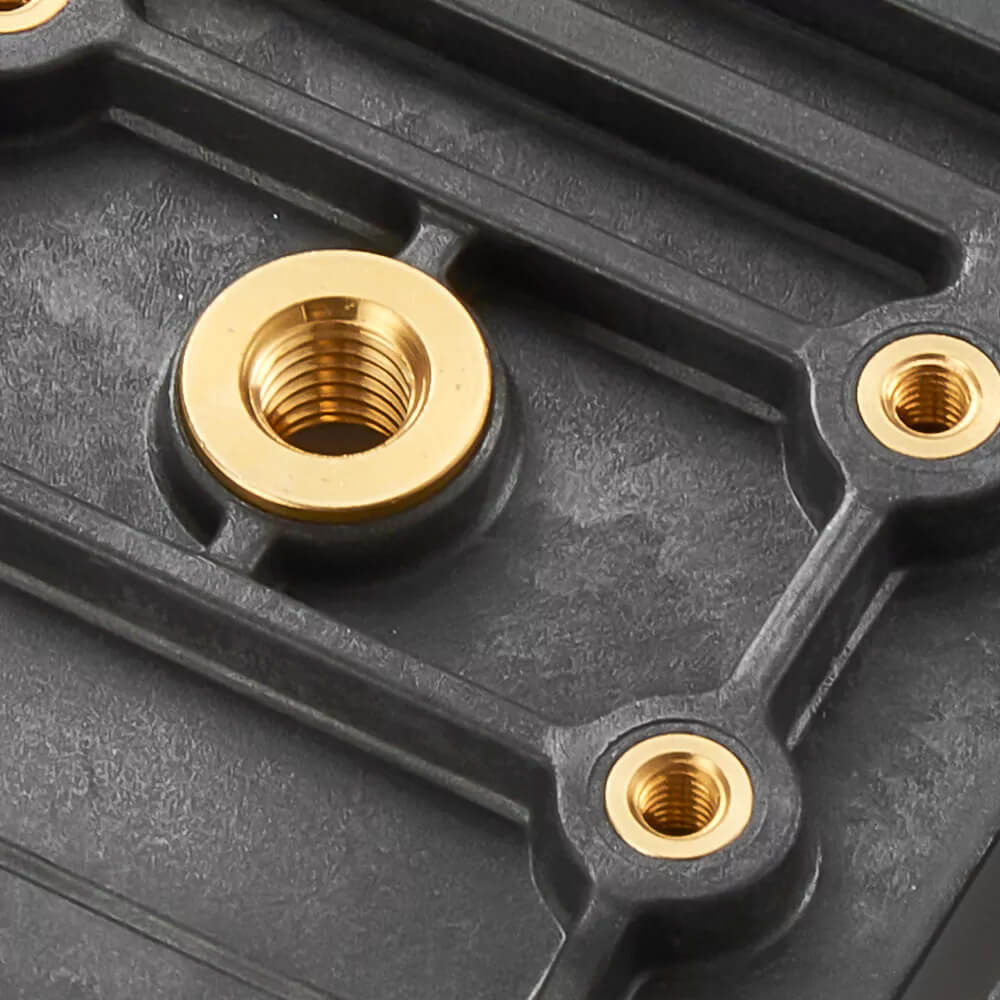
Insert Moulding is an injection moulding process in which a pre-manufactured component, known as an insert, is placed inside a mould before molten plastic is injected around or over it. The plastic solidifies and bonds with or mechanically locks around the insert to create a single finished component.
This process is commonly used to combine different materials, improve product strength, reduce assembly steps, and produce complex components with integrated features.
1. What Is Insert Moulding?
In insert moulding, a metal, plastic, ceramic, or other compatible component is positioned inside the mould cavity. Molten plastic is then injected into the cavity, surrounding the insert. Once the plastic cools and solidifies, the finished part is removed with the insert incorporated into it.
Basic process:
Insert Preparation → Insert Placement → Mould Closing → Plastic Injection → Cooling → Ejection
2. Main Components of Insert Moulding
| Component | Function |
|---|---|
| Mould Base | Supports and holds the mould components |
| Cavity | Forms the external shape of the plastic part |
| Core | Forms internal features and shapes |
| Insert | Pre-manufactured component incorporated into the product |
| Locating Features | Position and secure the insert inside the mould |
| Injection Nozzle | Transfers molten plastic into the mould |
| Runner and Gate | Direct molten plastic into the cavity |
| Cooling System | Removes heat and solidifies the plastic |
| Ejector System | Removes the finished moulded part |
| Guide Pins and Bushes | Maintain accurate alignment of mould halves |
3. How Insert Moulding Works
Step 1: Insert Preparation
The insert is manufactured separately and prepared for moulding. It may require cleaning, surface treatment, preheating, or inspection to ensure suitable bonding and dimensional accuracy.
Step 2: Insert Placement
The insert is positioned in the mould cavity manually, using a robotic system, or through an automated insert-loading mechanism. Locating features help prevent movement during injection.
Step 3: Mould Closing
The mould closes securely around the insert. Correct positioning is important to prevent misalignment, damage, or plastic leakage.
Step 4: Plastic Injection
Molten plastic is injected under controlled pressure into the mould cavity. The plastic flows around or over the insert, filling the required spaces.
Step 5: Cooling and Solidification
The plastic cools and solidifies around the insert. Depending on the material combination and design, the insert may be held by mechanical features, bonded through adhesion, or both.
Step 6: Mould Opening
After sufficient cooling, the mould opens and the finished component is ready for removal.
Step 7: Ejection and Inspection
The completed part is ejected and inspected for insert position, surface quality, dimensional accuracy, and any moulding defects.
4. Types of Inserts Used
Insert moulding can incorporate various pre-manufactured components.
| Insert Type | Common Applications |
|---|---|
| Metal Inserts | Brass threads, steel pins, aluminium components |
| Plastic Inserts | Preformed plastic parts and connectors |
| Ceramic Inserts | Electrical insulation and heat-resistant components |
| Electrical Inserts | Contacts, terminals, and conductive elements |
| Threaded Inserts | Screw connections and fastening points |
| Decorative Inserts | Product branding, labels, and appearance features |
Metal inserts are especially common because they can provide strong, durable fastening points within plastic components.
5. Advantages of Insert Moulding
- Reduced assembly: Combines multiple components into a single moulded product.
- Improved strength: Metal inserts can reinforce areas exposed to high loads.
- Reliable fastening: Threaded inserts provide durable screw connections.
- Compact design: Allows different materials and functions to be integrated into one component.
- Fewer production steps: Can reduce separate joining and assembly operations.
- Improved product consistency: Automated insert placement can provide repeatable positioning.
- Design flexibility: Supports products that combine plastic with metal or other materials.
6. Limitations of Insert Moulding
- Higher tooling complexity than basic injection moulding.
- Insert loading can increase cycle time.
- Inserts may shift during injection if not properly secured.
- Differences in thermal expansion can create internal stresses.
- Insert preparation and positioning require additional control.
- Some material combinations may have poor adhesion or chemical compatibility.
- Incorrect insert temperature or moulding conditions can cause defects.
7. Materials Used in Insert Moulding
The plastic material is selected according to the product’s strength, temperature, chemical, electrical, and appearance requirements.
Common thermoplastics include:
- ABS: Used for housings and consumer products.
- Polypropylene (PP): Used for lightweight and chemical-resistant parts.
- Polyamide (PA/Nylon): Used for strong engineering components.
- Polycarbonate (PC): Used where impact resistance and dimensional stability are important.
- PBT: Common in electrical and automotive components.
Inserts may be made from brass, stainless steel, aluminium, other plastics, or ceramics. Material compatibility and the intended joining mechanism must be evaluated during design.
8. Important Design Considerations
Insert Positioning: The insert must be securely located to prevent movement under injection pressure.
Material Compatibility: The insert and plastic should be compatible in terms of temperature, chemical interaction, and required bonding.
Insert Geometry: Knurls, grooves, holes, undercuts, and other mechanical features can help lock the plastic around the insert.
Wall Thickness: Uniform plastic thickness around the insert can help reduce uneven cooling, shrinkage, and internal stress.
Thermal Expansion: Differences in expansion between the insert and plastic must be considered to reduce cracking or loosening.
Gate Location: The gate should be positioned to promote suitable filling while minimizing insert movement and weld-line problems.
Cooling System: Uniform cooling helps reduce warpage and residual stresses around the insert.
Ejection: The mould should release the finished part without damaging the insert or the surrounding plastic.
9. Common Defects in Insert Moulding
| Defect | Possible Cause |
|---|---|
| Insert displacement | Poor locating or excessive injection force |
| Short shot | Insufficient material, pressure, or temperature |
| Flash | Poor mould closure or excessive injection pressure |
| Cracking around insert | Residual stress or thermal expansion differences |
| Weak bonding | Poor material compatibility or surface preparation |
| Sink marks | Uneven cooling or excessive local material thickness |
| Warpage | Uneven shrinkage or cooling |
| Insert loosening | Inadequate mechanical locking or bonding |
Careful mould design, insert positioning, process control, and inspection help minimize these defects.
10. Applications of Insert Moulding
Automotive Industry
- Sensor housings
- Electrical connectors
- Threaded mounting points
- Engine and interior components
Electrical and Electronics
- Switches
- Terminal blocks
- Connector housings
- Circuit-related components
Medical Equipment
- Instrument components
- Precision housings
- Components with integrated metal features
Consumer Products
- Appliance handles
- Power-tool components
- Fastening parts
- Plastic products with metal reinforcement
Industrial Products
- Mechanical fittings
- Reinforced plastic parts
- Threaded mounting components
- Equipment housings
11. Insert Moulding vs Overmoulding
| Feature | Insert Moulding | Overmoulding |
|---|---|---|
| Basic process | Plastic is moulded around a pre-manufactured insert | A second material is moulded over an existing part |
| Insert | Often metal, plastic, or ceramic | Commonly a pre-moulded plastic or other substrate |
| Main purpose | Integrate components or provide reinforcement | Add a layer, grip, seal, or other function |
| Typical example | Plastic part with a brass threaded insert | Plastic handle with a soft-touch rubber grip |
| Material combination | Often different material types | Often two polymers or compatible materials |
The processes can overlap in some applications, but they are generally distinguished by the type of pre-existing component and the purpose of the moulded material.
In Short
Insert Moulding is an injection moulding process that incorporates a pre-manufactured component into a plastic part by injecting molten plastic around or over it. It is widely used to create strong, compact, and functional products with integrated metal, plastic, ceramic, or electrical features.
Its main benefits are reduced assembly, improved fastening, and greater design flexibility, while successful production depends on accurate insert positioning, suitable material compatibility, and careful mould and process design.