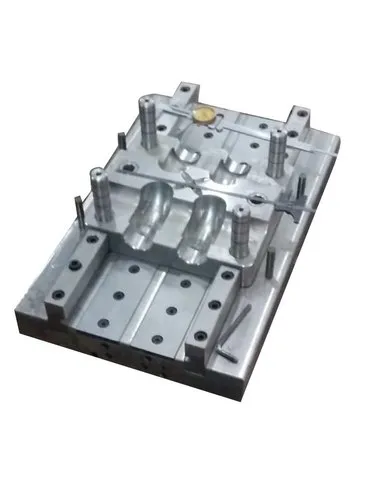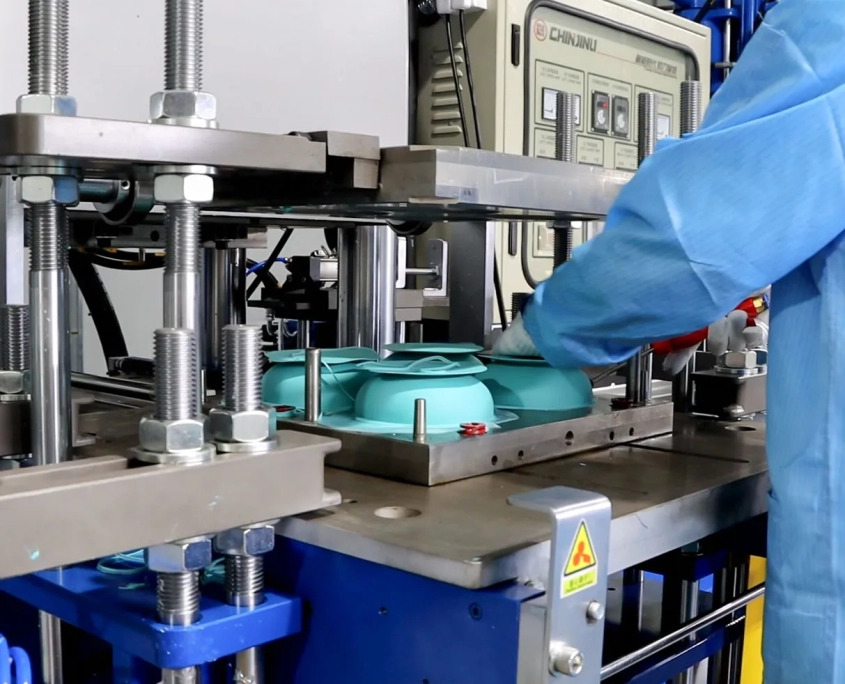
Silicone Compression Moulding is a manufacturing process used to produce silicone rubber components by placing a measured quantity of silicone material into a mould cavity and applying heat and pressure until the material cures and takes the required shape.
It is widely used for products requiring flexibility, temperature resistance, chemical resistance, and good sealing properties.
What Is Silicone Compression Moulding?
In this process, a pre-measured silicone rubber charge is placed directly into a heated mould. The mould is closed and pressure is applied.
Heat causes the silicone to cure, transforming the uncured material into a stable rubber component.
Silicone compression moulding is commonly used with high-consistency silicone rubber (HCR) and other suitable silicone compounds.
Silicone Compression Moulding Process
The basic process involves the following steps:
1. Silicone Material Preparation
The silicone compound is prepared and mixed with the required additives, pigments, and curing system.
2. Charge Preparation
A predetermined quantity of silicone is cut or prepared according to the mould cavity.
3. Mould Preparation
The mould surfaces are cleaned and, when required, a suitable release agent is applied.
4. Material Loading
The silicone charge is placed directly into the mould cavity.
5. Mould Closing
The upper mould closes against the lower mould.
6. Compression
Pressure causes the silicone to flow and fill the mould cavity.
7. Heating and Curing
Heat activates the curing system and converts the silicone into its final elastic form.
8. Mould Opening
After the required curing time, the mould is opened.
9. Part Removal
The cured silicone component is removed from the mould.
10. Trimming and Inspection
Excess silicone or flash is removed, and the component is inspected for quality.
Main Components of a Silicone Compression Mould
| Component | Function |
|---|---|
| Upper Mould | Compresses the silicone material |
| Lower Mould | Contains the mould cavity |
| Cavity | Creates the required product shape |
| Core | Forms internal features |
| Guide Pins | Maintain mould alignment |
| Heating System | Provides curing temperature |
| Vents | Allow trapped air and gases to escape |
| Flash Land | Controls excess silicone |
| Ejector System | Helps remove the finished part |
Types of Silicone Used
Different silicone formulations can be selected according to the application.
High-Consistency Silicone Rubber (HCR):
A commonly processed silicone material supplied as a solid rubber compound.
Heat-Cured Silicone Rubber:
Uses heat to activate the curing reaction and develop the required properties.
The choice of silicone depends on requirements such as temperature resistance, hardness, flexibility, transparency, electrical properties, and chemical resistance.
Advantages of Silicone Compression Moulding
- Suitable for complex silicone components
- Good flexibility and elasticity
- Excellent temperature resistance
- Good resistance to weathering and aging
- Suitable for electrical and sealing applications
- Can produce durable components
- Suitable for low- to medium-volume production
- Tooling can be relatively straightforward
- Suitable for different silicone colors and hardness levels
Limitations
- Cycle times can be relatively long depending on curing requirements.
- Flash may require trimming.
- Manual loading and unloading may be necessary.
- Charge weight must be controlled carefully.
- Material placement can affect final part quality.
- High-volume production may require more automated processes.
Silicone Compression Moulding vs. Silicone Injection Moulding
| Feature | Compression Moulding | Injection Moulding |
|---|---|---|
| Material Loading | Directly into cavity | Injected into cavity |
| Tooling Complexity | Generally simpler | Generally more complex |
| Production Speed | Moderate | Generally higher |
| Automation | Moderate | High |
| Material Preparation | Pre-measured charge | Metered/injected material |
| Suitable Production | Low to medium volume | Medium to high volume |
| Large Components | Can be suitable | Depends on equipment |
| Initial Tooling Cost | Generally lower | Generally higher |
Applications
Silicone compression moulding is commonly used to manufacture:
- Silicone gaskets
- Sealing rings
- O-rings
- Rubber pads
- Keypads
- Electrical insulation components
- Medical components
- Appliance seals
- Automotive components
- Flexible covers
- Protective caps
- Vibration-isolation components
Important Process Parameters
Mould Temperature: Must be controlled according to the silicone compound and curing system.
Pressure: Sufficient pressure is required to fill the cavity and achieve proper surface definition.
Cure Time: The silicone must remain under suitable heat and pressure long enough to achieve the required cure.
Charge Weight: Accurate charge quantity helps minimize flash and incomplete filling.
Material Placement: The silicone should be positioned properly in the cavity to encourage uniform filling.
Venting: Proper vents help prevent trapped air and surface defects.
Mould Design: Cavity geometry, parting lines, draft, flash lands, and ejector arrangements all affect production quality.
Common Defects
Some common problems include:
- Excessive flash
- Air bubbles
- Air traps
- Incomplete filling
- Uneven curing
- Surface marks
- Dimensional variation
- Poor surface finish
- Material sticking to the mould
- Inconsistent hardness
These defects can often be reduced through proper control of material quantity, mould temperature, pressure, curing time, venting, and mould design.
In Short
Silicone Compression Moulding uses heat and pressure to shape and cure silicone rubber inside a mould. It is particularly useful for producing flexible, heat-resistant, durable components such as seals, gaskets, keypads, electrical components, automotive parts, and medical products.
The quality of the finished component depends on proper control of silicone formulation, charge weight, mould temperature, pressure, curing time, venting, and mould design.