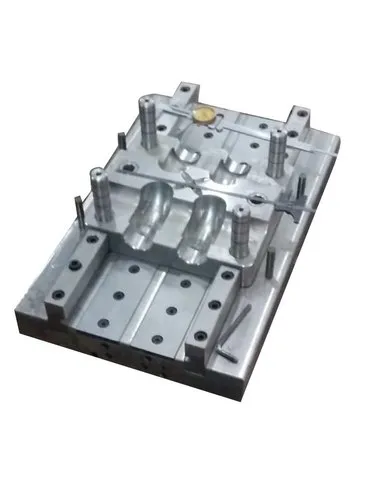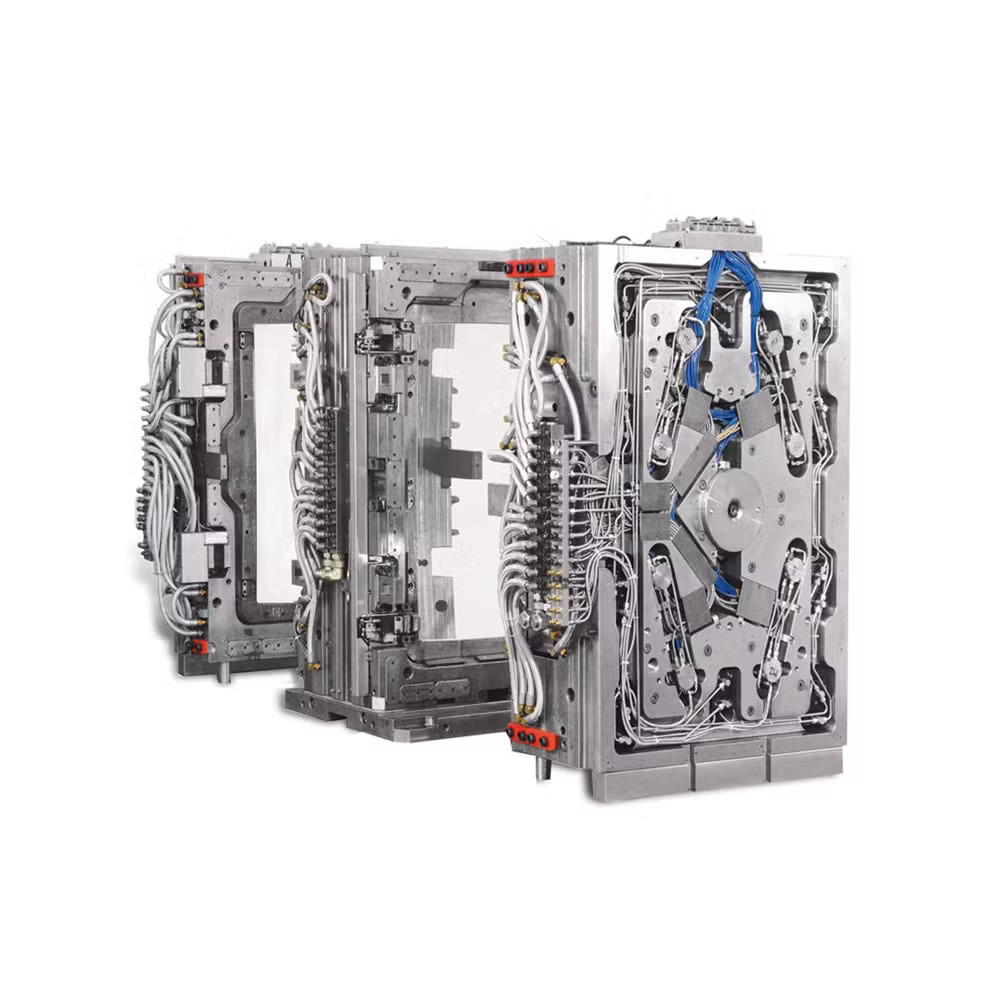
A Three-Plate Injection Mould is an injection mould design that uses three main plate sections and typically has two parting planes. This construction provides greater flexibility in gate placement and allows the runner system to separate from the moulded component during mould opening.
Three-plate moulds are commonly used when a conventional two-plate mould cannot provide the required gating arrangement or when a centrally located gate is desirable.
What Is a Three-Plate Injection Mould?
A typical three-plate mould consists of:
- Fixed mould section
- Middle or floating plate
- Moving mould section
The additional plate creates a second parting line. This allows the runner and gate system to be separated from the finished product during mould opening.
Main Components
| Component | Function |
|---|---|
| Fixed Plate | Supports the stationary mould section |
| Middle Plate | Controls separation of runner and moulded part |
| Moving Plate | Supports the moving mould section |
| Cavity | Forms the external shape |
| Core | Forms internal features |
| Sprue | Carries molten plastic from the machine nozzle |
| Runner | Distributes plastic to the gates |
| Gate | Controls plastic entry into the cavity |
| Guide Pins & Bushes | Maintain mould alignment |
| Ejector Pins | Remove the finished component |
| Cooling Channels | Control mould temperature |
| Support Plates | Provide structural support |
How a Three-Plate Injection Mould Works
The process generally follows these steps:
1. Mould Closing
The three mould sections are brought together and the mould is clamped.
2. Plastic Injection
Molten plastic enters through the sprue and flows through the runner system.
3. Cavity Filling
The plastic passes through the gates and fills the mould cavities.
4. Packing and Cooling
Pressure is maintained as required, followed by cooling until the plastic solidifies.
5. First Mould Opening
One parting plane opens, separating the runner system from the moulded component.
6. Second Mould Opening
The remaining mould section opens, allowing the finished component to be released.
7. Ejection
Ejector pins remove the moulded product.
Why Use a Three-Plate Mould?
One of the major benefits is greater flexibility in gate positioning.
A three-plate mould can use gates positioned away from the conventional edge-gate arrangement. This can be useful when:
- A central gate is required.
- The component has a large or complex shape.
- Balanced filling is important.
- Gate marks need to be positioned strategically.
- Multiple cavities require a particular runner arrangement.
Advantages
1. Flexible Gate Location
Gates can be positioned more freely than in many conventional two-plate designs.
2. Automatic Runner Separation
The runner can separate from the moulded component during mould opening.
3. Suitable for Multi-Cavity Moulds
Three-plate designs can provide useful runner and gate layouts for multiple cavities.
4. Improved Filling Options
Gate positioning can help achieve more balanced filling for certain product designs.
5. Reduced Manual Runner Removal
In suitable designs, the runner separates automatically during the mould-opening sequence.
Limitations
- More complicated construction than a two-plate mould.
- Higher tooling cost.
- More moving components.
- More demanding maintenance.
- Longer mould-opening movement may affect cycle time.
- More careful alignment is required.
- The additional parting mechanism can increase mould wear.
Three-Plate vs. Two-Plate Injection Moulds
| Feature | Two-Plate Mould | Three-Plate Mould |
|---|---|---|
| Main Plate Sections | Two | Three |
| Parting Planes | Usually one | Usually two |
| Gate Flexibility | Moderate | Higher |
| Construction | Simpler | More complex |
| Tooling Cost | Generally lower | Generally higher |
| Runner Separation | Depends on design | Can separate automatically |
| Maintenance | Easier | More involved |
| Suitable for Complex Gating | Limited in some designs | More suitable |
Common Gate Arrangements
Three-plate moulds are often associated with point gates or pinpoint gates, where plastic enters the cavity through a relatively small gate.
Other gating arrangements may also be used depending on the mould design and product requirements.
Applications
Three-plate injection moulds can be used for:
- Consumer products
- Electrical components
- Electronic housings
- Automotive components
- Medical components
- Packaging products
- Small precision components
- Multi-cavity plastic parts
- Products requiring centrally positioned gates
Important Design Considerations
Parting Line: The two parting planes must be carefully positioned to allow proper mould opening and part removal.
Gate Location: Gate position should provide suitable filling and acceptable gate marks.
Runner Layout: The runner system should be designed for efficient and balanced material flow.
Ejection: Ejector pins must remove the product without causing deformation.
Cooling: Proper cooling-channel design is essential for consistent cycle time and dimensions.
Mould Alignment: Accurate guide systems are important because the mould contains multiple moving sections.
In Short
A Three-Plate Injection Mould uses three main mould sections and typically two parting planes. Its major advantage is the additional flexibility it provides for gate positioning and runner separation.
Although it is more complex and generally more expensive than a two-plate mould, it can be valuable for multi-cavity products, complex gating requirements, and components where conventional edge gating is not suitable.